HIM (2025): Ending Explained
"Greatness demands sacrifice."
After suffering a potentially career-ending brain trauma, Cameron Cade receives a lifeline when his hero, legendary eight-time Championship quarterback and cultural megastar Isaiah White, offers to train Cam at Isaiah's isolated compound that he shares with his celebrity influencer wife. But as Cam's training accelerates, Isaiah's charisma begins to curdle into something darker.
9 min read
Release Year: 2025
Rating: 5.869/10
Runtime: 96 minutes
By Luna Sterling
HIM (2025): Ending Explained
In HIM (2025), director [redacted for spoiler purposes] crafts a pulsating descent into the underbelly of American football's mythic allure, where heroism curdles into horror. As a film critic, I've dissected countless tales of ambition and downfall, but this one's visceral grip lingers like the echo of a helmet cracking against bone. If you're here for the HIM ending explained—unpacking the blood-soaked finale, its psychological fractures, and those haunting ambiguities—buckle up. We'll navigate the plot twists without mercy, revealing how the film shatters illusions of glory on a desert altar.
Quick Recap
Young Cameron "Cam" Cade idolizes Isaiah White, the eight-time championship quarterback whose savage injury during a championship win etches itself into Cam's psyche like a scar. Years later, Cam emerges as a promising star, his path shadowed by his late father's mantra of sacrificial manhood and the support of his girlfriend and family. But a brutal ambush by a masked figure in a goat costume delivers a concussion that threatens to bench him for good, amplifying his paranoia and rage amid the high-stakes league combine.
Desperate to reclaim his shot, Cam skips the combine and accepts an offer from his agent, Tom, to train under Isaiah at his remote desert compound. There, amid the scorching isolation and Isaiah's magnetic yet menacing charisma, Cam endures twisted drills—face-smashing jug machines, ritualistic headbutts—that blur the line between preparation and punishment. Hallucinations of masked intruders plague him, fueled by secret injections of what he thinks is an energy booster but is actually Isaiah's blood. Tensions escalate with the arrival of deranged fans, a seductive encounter with Isaiah's influencer wife Elsie, and a chilling murder that exposes Isaiah's remorseless core. As Cam uncovers layers of manipulation—from the orchestrated attack to whispers of demonic rituals—the compound becomes a pressure cooker of betrayal, forcing him to confront whether stardom demands a soul-deep price.
What Happens in the Ending
The finale of HIM erupts in a feverish haze of violence and revelation, the air heavy with the acrid scent of sweat and iron-rich blood. Cam awakens submerged in an ice bath at the compound, his veins tethered to an IV dripping Isaiah's crimson essence—a forced transfusion meant to bind him to the legacy. Disoriented, his skin prickling from the chill, he yanks the needle free in a surge of defiance, injecting a mysterious serum smuggled by the team doctor Marco earlier. Clutching a jagged trophy like a primitive talisman, Cam stalks through the dim corridors, the distant hum of a television pulling him toward confrontation.
He finds Isaiah in a trance-like vigil, eyes glued to a looping video of roaring fans, their cheers a ghostly roar that vibrates through the walls. In a monologue laced with fevered intensity, Isaiah unveils the truth: he's the latest in a clandestine lineage of "G.O.A.T." quarterbacks, artificially elevated through ritual blood transfers that grant superhuman prowess. The compound's isolation amplifies the ritual's intimacy—the metallic tang of blood mingling with the dry desert wind seeping through cracks. To claim the mantle, Cam must kill Isaiah in ritual combat; the victor absorbs the full transfusion, perpetuating the cycle. What follows is a brutal melee: Cam seizes a helmet, its padding worn thin like faded glory, and bludgeons Isaiah repeatedly, the wet thuds echoing like thunder in a storm of fractured dreams. Isaiah crumples, lifeless, his blood pooling in dark rivulets across the floor.
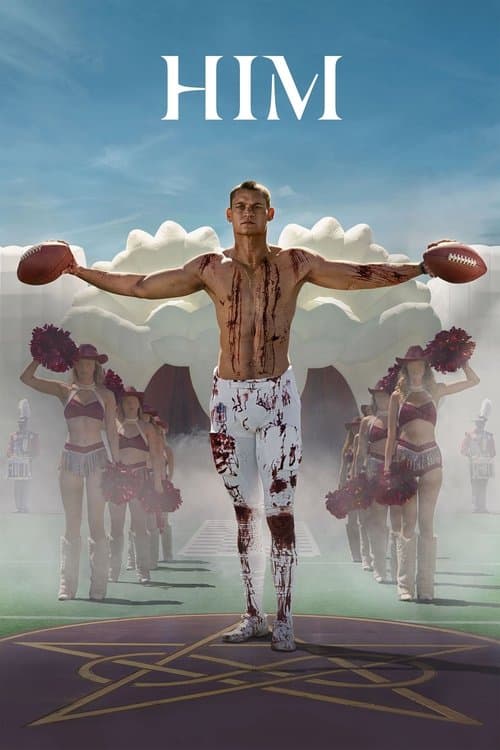
Staggering out, Cam emerges onto an makeshift football field under a merciless sun, the turf artificial and unforgiving. Waiting in ritualistic tableau are Elsie, the Saviors' owners, Tom, and others, their faces obscured by grotesque animal masks—goats, wolves, rams—that leer in the harsh light, evoking a primal, cultish ceremony. They proffer a contract, its paper crisp against the humid tension, revealing Cam's father orchestrated his path to this moment, including the initial masked assault by his trainer Malek to funnel him toward the Saviors. The air thickens with incense-like smoke from unseen braziers as they explain the blood rites' necessity for eternal victory. Cam, his vision blurring at the edges from the serum's burn, refuses. In a whirlwind of rage, he wields a hammer and sword, dispatching Elsie with a visceral swing that sprays mist into the air, slaughtering the owners in a frenzy of severed limbs and guttural cries. The masked Malek falls next, unmasked in death. He spares Tom momentarily, but an invisible force—perhaps the ritual's dark heart—drags Tom into a glowing pentagram, consuming him in a burst of otherworldly fury, the ground trembling like a heartbeat gone feral.
Bloodied and unbowed, Cam stumbles past a line of masked cheerleaders, their pom-poms rustling like whispers in the wind, and vanishes into the vast, sun-baked desert. The screen fades on his solitary figure, the horizon swallowing him whole, leaving only the faint, oppressive silence of the sands.
The Meaning Behind the Ending
At its core, the ending of HIM symbolizes the devouring myth of American masculinity and sports idolatry, where glory is a Faustian bargain sealed in blood. Isaiah's lineage represents the manufactured heroism of football's "G.O.A.T.s"—icons built not just on talent but on a hidden economy of sacrifice, their blood a metaphor for the life force drained from underdogs like Cam to fuel the elite. The ritual combat echoes gladiatorial rites, the helmet as a modern coliseum weapon underscoring how the game commodifies bodies, turning players into vessels for collective obsession. Cam's refusal to sign isn't mere rebellion; it's a rejection of the transfusion's promise of power, highlighting the film's theme of inherited trauma—his father's arrangement a generational curse, passing down not just ambition but its monstrous cost.
Psychologically, the finale delves into Cam's fractured psyche, the ice bath a baptismal purge mirroring his concussion-induced hallucinations, now crystallized into reality. The animal masks evoke a descent into bestial instinct, stripping away celebrity veneers to reveal the primal hunger beneath fandom and fame. Walking into the desert signifies exile from the system's gilded cage, a visceral liberation laced with isolation—the endless dunes a canvas for his unmoored soul, where victory's aftertaste is eternal vigilance against the shadows that birthed it.
Character Arcs and Resolution
Cam's arc culminates in a harrowing apotheosis, evolving from wide-eyed admirer to bloodied iconoclast. Once defined by Isaiah's shadow and his father's sacrificial ethos, Cam's journey through the compound's trials—hallucinations, betrayals, illicit temptations—shatters his illusions, forging a man who chooses authenticity over augmentation. His killings aren't triumphant but cathartic, a violent severing of paternal and cultural ties, leaving him scarred yet sovereign, wandering the desert as a ghost of his former self, forever altered by the psychological toll.
Isaiah resolves as the fallen god, his charisma rotting into fanaticism, his death a poetic inversion of his championship injury—bludgeoned not on the field but in its ritual heart. Elsie and the owners embody enablers of the cult, their demises underscoring complicity's price; Tom's destruction by the unseen force seals his arc as the ultimate opportunist, consumed by the machine he fed. Collectively, the ending denies neat closure, stranding characters in a limbo of consequence, where arcs bend but never fully break, mirroring the endless cycle of ambition's grind.
Alternate Interpretations
HIM toys with ambiguity through reported alternate endings, inviting viewers to question the finality of Cam's defiance. In one variant, Isaiah survives the bludgeoning, his resilience a nod to the lineage's unholy endurance. He watches from afar as Cam, now Saviors quarterback, clinches a Super Bowl victory on TV—implying Cam signed the contract off-screen, succumbing to the transfusion's allure. This reading casts the main ending as Cam's fleeting hallucination, a psychological denial before inevitable assimilation, emphasizing the system's inescapability: even "victory" is just another layer of control, the desert walk a delusional escape.
Another ending pivots to redemption without rites: Cam joins a rival team, leading them to a clean championship win, free of blood or masks. Yet, as he fixates on a spinning football—its rotations hypnotic, almost summoning—the film hints at lingering pursuit. This interpretation suggests the entities aren't conquered but patient, the "demonic forces" as internalized paranoia from his trauma. Is Cam truly liberated, or does the sport's psychic residue doom him to eternal haunting? These variants amplify the film's thematic ambiguity, blurring resistance and resignation, and urging audiences to debate whether escape is illusion or the true horror lies in half-measures.
Themes and Symbolism
The ending reinforces HIM's core themes of toxic legacy and the occult undercurrents of celebrity, subverting football's heroic narrative into a horror of commodified souls. Blood symbolism dominates—the transfusions as vampiric inheritance, echoing how the NFL drains players' bodies for spectacle, while the pentagram evokes satanic pacts, literalizing the "selling your soul" trope. Masks symbolize fractured identities, the animal motifs tying into the goat-headed ambush and Isaiah's G.O.A.T. status, a biblical inversion where the "greatest" are beastly idols.
Broader, the film critiques fandom's fanaticism—cheerleaders and owners as cult acolytes—and the psychological isolation of pursuit, the desert a vast metaphor for the void left by rejected belonging. It subverts redemption arcs by denying easy heroism; Cam's violence doesn't purify but perpetuates the cycle, questioning if true escape exists in a world built on sacrifice.
Final Thoughts
HIM's ending is a masterstroke of atmospheric dread, its visceral clashes and symbolic depths leaving a metallic aftertaste that haunts long after the credits. It works brilliantly by embracing ambiguity, forcing us to confront the film's thesis: glory's throne is built on bones, and walking away might be the loneliest win. For sports fans and horror aficionados alike, this finale doesn't just explain— it imprints, a reminder that some idols demand your blood, drop by drop. If HIM lingers in your mind like a concussion's fog, that's its genius: in the end, we're all running toward or from something shadowed.