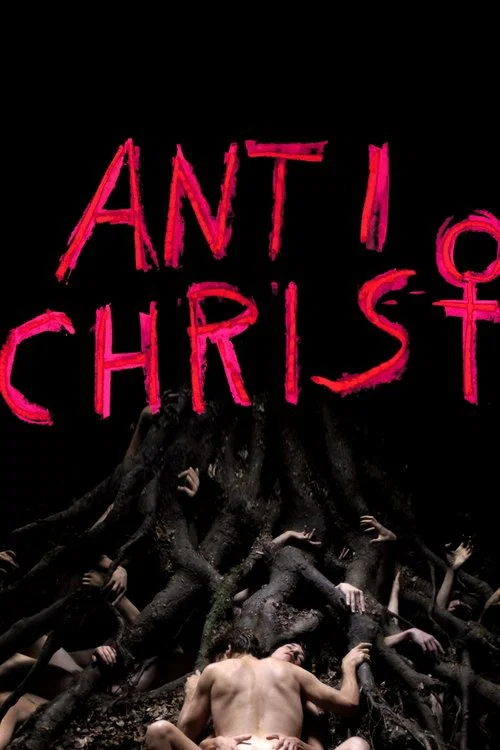
Antichrist (2009): Ending Explained
She admits she let their son fall and cuts off her clitoris; he strangles her, burns her body, and limps free as women with blurred faces pass.
7 min read
Release Year: 2009
Rating: 6.6/10
Runtime: 104 minutes
By Ending Explained Team
The short answer
The short answer
She confesses. In the cabin, the woman tells the man that on the night Nic died she saw him climbing toward the window and let him fall on purpose. Then she cuts off her clitoris. The crow, the deer, and the fox, the Three Beggars she said must arrive before he could die, come to the cabin and a hailstorm starts. He finds the wrench under the cabin's floorboards, she attacks him with scissors, and he gets the grindstone off his leg. He strangles her, burns her body on a pyre, limps away eating wild berries, and climbs a hill where hundreds of women in old-fashioned clothes, their faces blurred, walk past him deeper into the forest.
The last twenty minutes

Out of the hole
She digs him out of the foxhole and helps him back to the cabin. She can't remember where she threw the wrench, which keeps the grindstone bolted through his leg. What she gives him is a rule instead of a rescue: he can only die, she says, when the Three Beggars arrive.
The confession
She tells him she watched Nic climb toward the window on the night he died and chose to let him fall. This is the film's real reveal, and it costs her the last thing she had, which was the story that her grief was also concealment. While writing her thesis criticizing gynocide, she formed the belief that all women are inherently evil.
The mutilation and the hailstorm
In the cabin she cuts off her clitoris. The crow, the deer, and the fox appear, and hail starts falling. The film established earlier that women accused of witchcraft were said to be able to summon hailstorms, so the weather arriving now ties her to the witches in her own research.
The wrench
He finds the wrench under the cabin's floorboards. She comes at him with scissors. He gets the bolt loose and the grindstone off. He is mobile again, and that is the whole turn: the wrench she tossed under the cabin and lost is what frees him once he finds it under the floorboards.
The killing
He strangles her to death. He builds a pyre and lights it, cremating her body. The person who confessed to letting a child fall is dead by his hands, and he has done it after the Three Beggars arrived.
The hill
He limps out of the cabin and eats wild berries while the Three Beggars watch, now translucent and glowing. Under a brilliant light he reaches the top of a hill and sees hundreds of women in antiquated clothing, faces blurred, walk past him deeper into the forest.
The ledger
What he walks away with
He survives. The condition she set for his death arrives with the Three Beggars, and he ignores it. He gets the confession nobody bargained for: that Nic's death was not an accident. He gets the wrench, the leg free, and the last word in the argument the whole trip was.
What it took
He pays with a body that has been drilled, bolted, and buried. He pays with the son, and with the fact that the confession he gets is a confession of murder, which makes him the husband of a woman who let their child fall and then the man who killed her.
What she is released from
She stops carrying the secret. She says the thing out loud, and she acts out her own verdict on herself before he can. The hailstorm and the Three Beggars arrive, which means the belief she formed while writing that thesis finally answers her.
What it costs
She pays with her clitoris, her life, and her body, which ends on a pyre he lights. The rule she set for his death is met, and he kills her anyway: she is strangled before the terms she set can be honored.
What is settled
Nic is the only one of the three who never had a say. His death is the fact the entire film orbits, and by the end it is no longer an accident. His mother has said she let it happen.
What is not
Nic pays for all of it. The shoes on the wrong feet, the summer at Eden, the fall from the window: he is the debt everyone else is settling, and his one scene is the fall the two adults spend the film fighting over.
The irony

She wanted to be understood as evil, and she gets exactly that, from the one person who spent the whole film refusing to accept it. The man came to Eden to treat her, to argue her out of the thesis, to insist that her belief that all women are inherently evil was a symptom and not a truth. By the end he has killed her. The film hands her the confirmation she was fishing for and hands him the role of executioner, and neither of them gets to enjoy it. She dies in a hailstorm she is supposed to have summoned. The autopsy and the photos of Nic expose the shoes, and her account of the fall finishes it; he gets the truth about his son and it destroys the last reason to keep her alive. The ending does not punish the guilty party and spare the innocent. It settles the account between two people who both owe the same debt, and only one of them is left standing to pay it.
Did anyone get a warning
The earliest hint is the hike, before any of the violence. He sees a deer that does not run from him, and the deer has a stillborn fawn hanging halfway out of her. Nothing in the scene explains itself. It just shows a mother animal carrying a dead child, unafraid, and it is the first time the forest behaves like it is on her side rather than his. Everything that follows, the fox that tells him "chaos reigns," the acorns hammering the roof, the ticks, the crow buried alive, is that deer repeating itself in worse forms. When the woman says he can only die when the Three Beggars arrive, she is naming animals he has already met. The film told him where this was going on the walk in.
Gruesome, explicit and highly controversial; Lars von Trier's arthouse-horror, though beautifully shot, is no easy ride.
The verdict
The verdict
She is worse off, and the film thinks she earned it. That is the uncomfortable part, and it is why the hailstorm and the Three Beggars matter. The crow is despair, the deer is grief, the fox is pain, and they arrive for her. She criticized gynocide in her thesis, she put Nic's shoes on the wrong feet until his feet deformed, she watched him climb and let him fall, and then she told the man all of it. The film does not offer her a defense and does not ask you to construct one. What it does instead is refuse to let the man off either. He survives, but he survives as the man who strangled his wife and burned her, and the last image is not triumph. It is a procession of women with blurred faces walking past him into the trees, moving deeper into the forest. He is not absolved by outliving her. He is just the one who is still there, standing on a hill, eating berries, watching the women go by, and the film lets him watch. That is the punishment Antichrist actually deals out: not death for the guilty, but survival for the man who got the truth.