Mothering Sunday (2021): Ending Explained
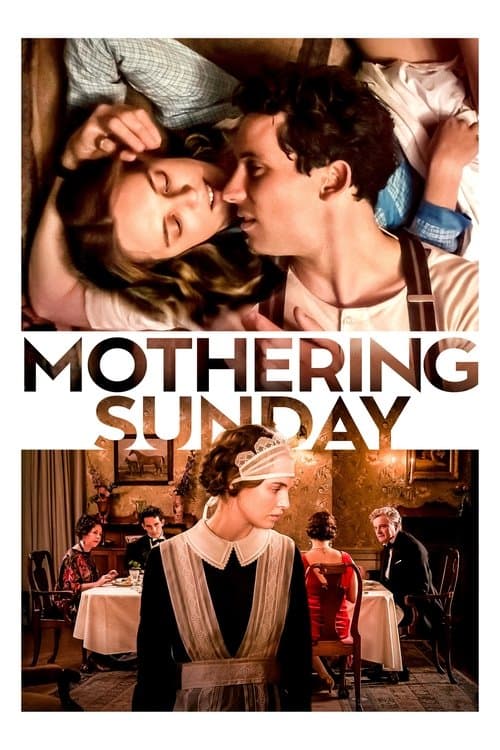
On a warm spring day in 1924, house maid and foundling Jane Fairchild finds herself alone on Mother's Day. Her employers, Mr. and Mrs. Niven, are out and she has the rare chance to spend quality time with her secret lover. Paul is the boy from the manor house nearby, Jane's long-term love despite the fact that he's engaged to be married to another woman, a childhood friend and daughter of his parents' friends. But events that neither can foresee will change the course of Jane's life forever.
8 min read
Release Year: 2021
Rating: 5.3/10
Runtime: 104 minutes
By Ellis Carver
Mothering Sunday (2021): Ending Explained
Quick Recap
In the sun-dappled English countryside of 1924, Jane Fairchild, a young orphan and housemaid for the affluent Niven family, navigates a life of quiet servitude shadowed by a passionate, forbidden affair. Her lover is Paul Sheringham, the charming heir to a neighboring estate, whose easy privilege contrasts sharply with Jane's constrained world. On Mothering Sunday—a day that underscores her own maternal void—Jane is granted rare freedom when the Nivens leave for a social lunch. Paul, despite his impending marriage to Emma Hobday, a union born of postwar obligations and familial expectations, invites Jane to his empty family home. There, their intimacy unfolds in a moment of stolen bliss, only for Paul to rush off to join his fiancée, leaving Jane to wander the grand house in a state of unbridled vulnerability.
As Jane cycles back to the Niven estate, the day shatters: Paul has perished in a car accident en route to the lunch. Devastated but masking her grief, Jane accompanies her employer, Godfrey Niven, to the Sheringham home, where the maid Ethel reveals she has meticulously cleaned Paul's room, finding no suicide note—though whispers of one linger unspoken. That evening, Mrs. Niven, haunted by the loss of her own sons in the Great War, confides in Jane about the cruelty of bereavement, ironically blessing her orphan status as a shield against further pain. Unable to sleep, Jane turns to a journal, her words marking the tentative birth of her voice as a writer.
The narrative then leaps forward, revealing Jane's transformation. She marries Donald, a thoughtful philosopher she meets at a bookshop, and emerges as a celebrated author. Yet her past remains a guarded secret: when Donald inquires about the "three reasons" she became a writer—citing her birth and a gifted typewriter as the first two—she withholds the third, the seismic day of Paul's death. As Donald faces his own mortality from an inoperable brain tumor, he pleads for that hidden truth, but Jane offers only her love, preserving her inner sanctum even in their most intimate hours.
What Happens in the Ending
The film's poignant close unfolds in Jane's later years, shifting to a sunlit scene at her home where she, now an elderly woman, is confronted by eager members of the press. They have descended upon her following news of yet another prestigious literary award, a testament to her enduring success as a writer. Jane, seated with a quiet dignity that speaks of a life richly lived yet deeply private, listens impassively as the journalists buzz with congratulations and questions. Her response is measured and dismissive: she informs them that she has already claimed every available literary prize, rendering this one redundant in her eyes. Undeterred by their enthusiasm, she politely but firmly ushers them away, retreating indoors to her familiar sanctuary.
In the final moments, the camera lingers on Jane at her typewriter, her fingers poised over the keys. The room is bathed in soft light, evoking the warmth of that long-ago spring day, as she resumes her work with a serene focus. There is no dramatic flourish—no tearful revelation or triumphant declaration. Instead, the screen fades on this image of quiet creation, leaving Jane immersed in the act of writing, her past and present converging in the steady rhythm of her typing.
The Meaning Behind the Ending
This understated finale encapsulates the film's meditation on creation born from absence, where Jane's return to the typewriter symbolizes not just artistic persistence but a profound reclamation of self. The typewriter, introduced earlier as one of the "three reasons" for her writing life, stands as a metaphor for transformation: a machine that turns raw emotion into enduring narrative, much like how Jane alchemizes her grief into literature. Her indifference to the press and awards underscores a rejection of external validation, highlighting the internal alchemy of art—writing as a private ritual of processing loss, rather than a bid for acclaim.
Thematically, the ending probes the moral complexity of survival amid societal constraints. Jane's orphanhood, once a mark of deprivation, becomes a paradoxical freedom, allowing her to forge an identity unbound by the rigid class and gender expectations that ensnared Paul and Emma. The intrusion of the press evokes the voyeurism of the upper class that Jane once navigated naked in their home, now inverted as she guards her story. It suggests that true resolution lies in solitude, where the "third reason"—Paul's death and the day's revelations—fuels an ongoing dialogue with the self, free from the judgments of a world that once defined her by her station.
Character Arcs and Resolution
Jane's arc is the film's emotional core, evolving from a voiceless maid, defined by her service and secret desires, to a self-possessed author whose inner world becomes her greatest legacy. The ending resolves her journey by affirming her autonomy: the typewriter is her anchor, a tool that has carried her through Paul's sudden absence, Donald's lingering illness, and the weight of unspoken truths. By withholding the "third reason" from Donald, even on his deathbed, Jane asserts her psychological boundaries, choosing love and mystery over confession. Her old-age poise—unfazed by accolades—signals a hard-won peace, where writing serves as both catharsis and defiance against a life of imposed silence.
Paul's arc, tragically truncated, underscores the fragility of privilege; his death propels Jane's growth but leaves his obligations to Emma unfulfilled, a commentary on the hollow rituals of postwar aristocracy. Donald, in turn, represents a complementary partnership—his philosophical bent nurturing Jane's literary voice—yet his plea for her secret highlights the limits of even intimate bonds. The ending ties these threads by centering Jane alone, her resolution not in relational closure but in the solitary act of creation, a testament to her resilience amid layered losses.
Alternate Interpretations
While the ending appears resolute in its focus on Jane's creative solitude, its ambiguity invites multiple lenses. One reading sees her return to the typewriter as a final confrontation with the past: perhaps she is at last articulating the "third reason," weaving Paul's memory into her work as a form of belated mourning, transforming personal tragedy into universal truth. This interpretation emphasizes psychological healing, where the award's timing suggests external recognition finally aligns with her internal readiness to voice her story.
Alternatively, the scene could portray a subtle weariness—a quiet subversion of triumph. Jane's curt dismissal of the press might hint at disillusionment with fame's superficiality, implying that her writing has become an escape from, rather than an engagement with, the world. In this view, the ending is less about resolution and more about perpetual deferral, mirroring the film's nonlinear structure: Jane's life as an endless draft, forever revised but never fully disclosed. These possibilities underscore the film's contemplative ambiguity, leaving viewers to ponder whether her typing signals closure or an eternal loop of reflection.
Themes and Symbolism
The ending reinforces core themes of loss and reinvention, subverting the pastoral idyll of 1920s England to expose its undercurrents of class disparity and emotional isolation. Mothering Sunday itself emerges as a ironic symbol: a day celebrating maternal bonds that, for the childless Jane, illuminates her freedom from grief's heavier chains, as Mrs. Niven observes. Yet it also critiques societal facades—Paul's engagement as a dutiful mask over personal longing, much like the cleaned Sheringham bedroom that erases traces of Jane's presence, symbolizing how the lower classes are effaced from elite narratives.
Sexuality and autonomy weave through as metaphors for agency: Jane's naked exploration of the Sheringham house prefigures her later intellectual undressing of experiences through writing. The typewriter, a recurring emblem, contrasts the era's rigid hierarchies, offering Jane a democratizing tool to author her destiny. Broader societal commentary lingers in the postwar context—bereavement as a shared scar, yet one that orphans like Jane navigate with unexpected liberation—challenging romanticized notions of family and fate.
Final Thoughts
Mothering Sunday's ending works masterfully through its restraint, eschewing melodrama for a subtle profundity that mirrors life's quiet profundities. By framing Jane's twilight years in creative isolation, director Eva Husson and the screenplay honor the moral ambiguities of human endurance: grief as both wound and wellspring, secrecy as self-preservation. For audiences grappling with the film's elegiac tone, this close feels earned—a thoughtful coda that elevates personal history into something timeless, reminding us that the deepest stories are often the ones we tell ourselves, one keystroke at a time. It's a fitting capstone to a narrative rich in unspoken depths, inviting rewatches to uncover layers of its contemplative grace.