Exam (2009): Ending Explained
"How far would you go to win the ultimate job?"
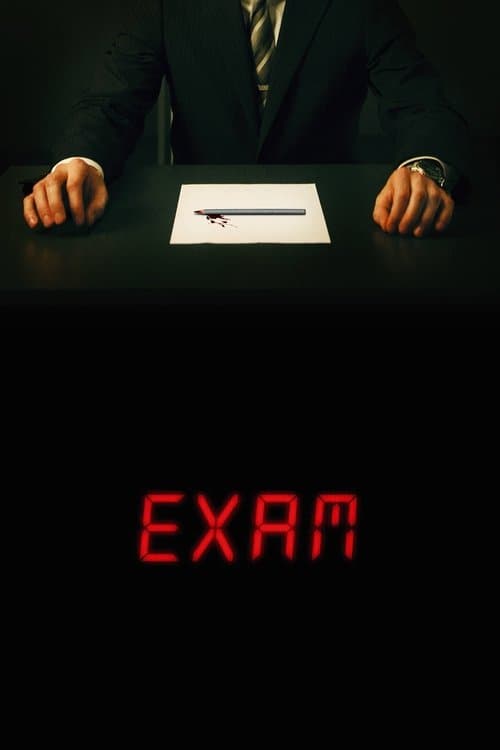
Eight talented candidates have reached the final stage of selection to join the ranks of a mysterious and powerful corporation. Entering a windowless room, where an armed guard keeps watch, they are given 80 minutes to answer one simple question.
8 min read
Release Year: 2009
Rating: 6.702/10
Runtime: 97 minutes
By Luna Sterling
Exam (2009): Ending Explained
In the claustrophobic confines of Exam (2009), director Stuart Hazeldine crafts a psychological pressure cooker that simmers with paranoia and desperation. As Luna Sterling, I've dissected countless thrillers, but this one's ending lingers like a shadow in a dimly lit corridor—subtle, revelatory, and laced with the metallic tang of betrayal. If you're searching for a breakdown of Exam's twisty finale, you've come to the right place. We'll peel back the layers of this mind-bending corporate gauntlet, exploring how its conclusion transforms a simple job interview into a visceral meditation on survival, ethics, and human nature.
Quick Recap
The film traps eight ambitious candidates in a stark, windowless room for what promises to be the ultimate job interview at the enigmatic Biorg corporation. Dressed in crisp white shirts that soon become stained with sweat and suspicion, they sit at numbered desks, each facing a blank sheet of paper inscribed only with "candidate" and a digit from one to eight. The Invigilator, a stern figure with an air of detached authority, lays down the rules: 80 minutes to answer one question, but no spoiling the paper, no leaving the room, and no speaking to him or the armed guard at the door. Violations mean instant disqualification. With a curt "Any questions?" he exits, leaving the group in the hum of fluorescent lights and the weight of unspoken dread.
As the timer ticks down, the blank papers ignite a frenzy of collaboration and conflict. Nicknamed by the manipulative White—Black, Blonde, Brown, Brunette, Dark, and the silent Deaf—the candidates probe the sheets with lights, fluids, and even fire from sprinklers, desperate to uncover hidden text. Tensions escalate as White seizes control, orchestrating disqualifications through cunning sabotage. Revelations trickle out like blood from a fresh wound: Biorg has pioneered a miracle drug curing a viral pandemic that ravages the world, but the company's CEO remains a ghost. Paranoia festers—Black carries the virus, White needs medication, Dark knows too much about the firm. Violence erupts: beatings, torture, a stolen gun that demands a fingerprint to fire. Bodies drop, literally and figuratively, as the room's sterile air thickens with the acrid scent of fear and betrayal.
By the final stretch, only White, Black, and Blonde remain viable, the others ejected into disqualification's void. White taunts with hints of a nonexistent question, suggesting survival is the true test. Black's aggression peaks, Blonde clings to fragile alliances, and Deaf's eerie silence masks deeper machinations. The clock winds inexorably toward zero, the room pulsing with the ragged breaths of the desperate, setting the stage for a denouement that shatters the illusion of the exam's simplicity.
What Happens in the Ending
The finale unfolds in a blur of shadows and sudden violence, the room's oppressive atmosphere closing in like a vice. With mere minutes left, White has outmaneuvered most rivals: Brown is coerced into stepping outside, his disqualification echoing in the sudden silence. Blonde, feigning defeat, slips into the hallway but keeps one foot planted inside the room's threshold—a precarious limbo that saves her from elimination. In the ensuing darkness—triggered when Blonde kills the voice-activated lights—Black lunges at White, the two grappling in a primal tangle of grunts and thuds against the cold floor.
The lights flicker back on to a shocking tableau: Black sprawls wounded, a gunshot wound blooming red across his shirt, the air heavy with the sharp crack of gunfire and the coppery scent of blood. White, gun in hand, stands triumphant, his face twisted in predatory glee. He advances on Blonde's hiding spot in the hallway, the guard's shadow looming inert nearby. But before he can deliver the fatal shot, the timer hits zero with a final, ominous chime, bathing the room in a hush broken only by labored breathing.
White, smug in his isolation, turns to the returning Invigilator, declaring victory. Yet the Invigilator's voice cuts through like ice: White is disqualified. Confusion ripples as the truth unravels—Deaf, the mute observer long dismissed, had tampered with the clock earlier, shaving off crucial minutes with sleight of hand. Blonde, piecing together fragments from the chaos, recalls Deaf's earlier tinkering with glasses and shards of glass over an exam paper. Donning the abandoned spectacles, she peers at her sheet and discovers the question in tiny, nearly invisible script: "Question 1." It dawns on her—this refers to the Invigilator's opening query: "Any questions?"
With poised clarity, Blonde utters a single word: "No." The Invigilator nods, entering to reveal the deeper layers. Deaf is no victim but Biorg's elusive CEO, the architect of the virus cure and a revolutionary cell regeneration serum—"the gift of life." The bullet that felled Black? Laced with this serum, it revives him in a gasp of labored coughs, his body knitting back from the brink. Demand for the drug outstrips supply, demanding an administrator of ruthless precision, moral fortitude, and empathy—qualities Blonde alone embodied amid the carnage. She accepts the position, the door swinging open to a world beyond the room's suffocating grip, as the screen fades on her resolute expression.
The Meaning Behind the Ending
At its core, the ending of Exam strips away the corporate facade to expose the raw mechanics of power and selection, where the "question" is less about intellect than unflinching integrity. The minuscule "Question 1" symbolizes the exam's deceptive simplicity—a test hidden in plain sight, mirroring how opportunities in a cutthroat world demand seeing beyond the obvious. Blonde's "No" isn't mere compliance; it's a rejection of the chaos sown by ambition, affirming that true qualification lies in restraint amid temptation. The room, with its unyielding walls and ticking clock, becomes a metaphor for the soul under siege, the psychological toll of isolation amplifying every whispered doubt and calculated strike.
Thematically, the finale underscores survival as a moral crucible. Biorg's miracle drug, born from a pandemic's shadow, represents humanity's fragile grasp on redemption, but its scarcity evokes the ethical quagmires of resource allocation—who lives, who doesn't? White's downfall, pleading for his medication only to be cast aside, highlights the irony: the virus afflicts all, yet compassion is the rarest cure. Deaf's reveal as CEO elevates the test to a divine judgment, the room a confessional where sins of greed and violence are tallied in the dim glow of revelation.
Character Arcs and Resolution
Blonde's arc crescendos from tentative observer to ethical anchor, her quiet resolve amid the frenzy marking her as the ideal steward for Biorg's burdens. She navigates alliances with a visceral empathy—reviving White with stolen meds, hesitating in violence—culminating in her poised answer that seals her triumph. It's a resolution that feels earned, her foot in the door a literal and figurative stand against expulsion.
White embodies unchecked ambition's corrosion, his control-freak machinations unraveling into convulsions and disqualification. His arc peaks in hubris, the gun's weight in his hand a false scepter, leaving him broken in the room's unforgiving light. Black's journey, shadowed by his viral burden, resolves in redemption: the bullet's cure not just physical but symbolic, pulling him from death's edge to witness Blonde's ascension. The others—Brunette's naivety, Dark's guarded secrets, Brown's opportunism—fade into disqualified obscurity, their arcs cautionary tales of how pressure fractures the facade of civility. Deaf, the silent puppeteer, resolves as the omniscient force, his feigned vulnerability a masterful arc that redefines the game's architects.
Alternate Interpretations
While the ending's mechanics are explicit, ambiguities swirl around Deaf's intentions and the exam's authenticity. One reading posits the entire ordeal as a simulation, the "gift of life" serum blurring lines between reality and test—did Black truly die and revive, or was it staged to probe reactions? This interpretation casts the room as a psychological mirror, where disqualifications reflect internal flaws rather than literal rules.
Another lens views Blonde's hiring through a cynical filter: Is she truly compassionate, or has the system co-opted her survival instincts into corporate ruthlessness? The CEO's praise for her "tough decisions" could imply she'll enforce the drug's scarcity with the same cold logic that doomed the others, subverting her arc into tragic irony. These ambiguities linger like the room's stale air, inviting viewers to question whether victory corrupts or elevates.
Themes and Symbolism
The ending reinforces Exam's core themes of isolation and moral ambiguity, subverting the job interview trope into a Darwinian ritual where collaboration curdles into cannibalism. Symbolically, the blank papers evoke existential voids—life's unanswered questions demanding creative, often destructive, interpretation. The gun, fingerprint-locked, symbolizes inaccessible power, wielded only through coercion, while the tampered clock warps time itself, underscoring how perception dictates reality in high-stakes confinement.
Broader motifs of disease and cure permeate: the pandemic as societal rot, Biorg's serum as elusive salvation. The windowless room, humming with tension, symbolizes the corporate labyrinth—sterile yet seething, where light (literal and metaphorical) reveals truths only to the worthy. The finale subverts expectations of overt violence triumphing, instead crowning subtlety and ethics, a quiet rebuke to the era's cutthroat capitalism.
Final Thoughts
Exam's ending is a masterstroke of restrained revelation, transforming 80 minutes of escalating dread into a cathartic exhale that rewards patient viewers. It works because it doesn't overexplain, allowing the psychological residue—the echo of shouts in empty space, the chill of disqualification—to haunt long after credits roll. In a film where every breath feels measured, Blonde's simple "No" resonates as profoundly as any twist, reminding us that in the pressure chamber of ambition, the real test is holding onto your humanity. If you've emerged from this white-shirted nightmare puzzled yet provoked, that's the point—it's cinema that doesn't just entertain, but interrogates the soul.