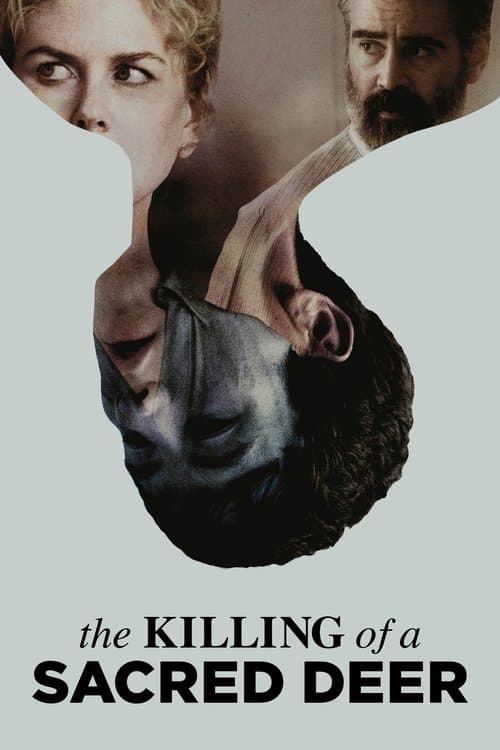
The Killing of a Sacred Deer (2017): Ending Explained
Dr. Steven Murphy is a renowned cardiovascular surgeon who presides over a spotless household with his wife and two children. Lurking at the margins of his idyllic suburban existence is Martin, a fatherless teen who insinuates himself into the doctor's life in gradually unsettling ways.
9 min read
Release Year: 2017
Rating: 7.01/10
Runtime: 121 minutes
By Luna Sterling
The Killing of a Sacred Deer (2017): Ending Explained
By Luna Sterling
Yorgos Lanthimos's The Killing of a Sacred Deer lingers like a chill in the marrow, a slow-drip descent into familial dread and moral rot. If you're searching for a breakdown of this film's haunting finale—those final, gut-wrenching moments that leave you questioning the fragile veneer of suburban life—then you've come to the right place. We'll dissect the literal events, peel back the layers of symbolism, and explore the psychological undercurrents that make this ending so viscerally unforgettable. Spoilers ahead, naturally; this is no place for the uninitiated.
Quick Recap
In the sterile glow of Cincinnati's medical corridors, Dr. Steven Murphy (Colin Farrell) embodies precision and control—a cardiothoracic surgeon whose scalpel hand never falters. His life unfolds in a pristine suburban bubble with wife Anna (Nicole Kidman), daughter Kim (Alicia Silverstone), and young son Bob (Sunny Suljic), a tableau of domestic harmony shadowed only by the faint hum of routine. But into this ordered world slithers Martin (Barry Keoghan), a pale, fatherless teenager whose eyes hold the weight of unspoken grievances. Their connection traces back to a botched surgery: Steven operated on Martin's father years ago, a procedure muddled by pre-op drinks, ending in the man's death on the table.
As Martin weaves himself into the Murphy fold—first as a curious guest, then a persistent specter—his presence stirs unease like a draft through cracked windows. Dinners turn awkward, flirtations from Martin's mother unsettle Steven, and Martin's cryptic complaints of chest pain echo the surgeon's buried guilt. The intrusion escalates when Martin rides Kim home on his motorcycle, sparking a forbidden teenage infatuation. But the true horror unfurls one crisp morning: Bob awakens paralyzed from the waist down, his small body rigid against the bedsheets. Hospital tests yield nothing, yet Martin's visits persist, his voice a low murmur of inevitability. He reveals the curse—a biblical reckoning for Steven's negligence. To atone, Steven must sacrifice one family member; otherwise, paralysis will creep upward, starvation will gnaw from within, and death will weep from their eyes.
Desperation thickens the air in the Murphy home. Kim collapses mid-choir hymn, her voice choking on an apple slice, joining Bob in a haze of feeding tubes and futile therapies. Anna confronts the unraveling truth, her composed facade cracking under Martin's unyielding gaze. Steven's attempts to silence the boy—tying him in the basement, the metallic tang of blood from a gunshot wound to Martin's leg—only amplify the tension, Martin's calm defiance a venomous bite against Steven's arm. The children, once playful, now plead and scheme, their innocence curdling into survival's sharp edge. As the family's vitality ebbs, the weight of choice presses like an invisible noose, leading inexorably to the film's shattering climax.
What Happens in the Ending
The ending of The Killing of a Sacred Deer unfolds with a suffocating intimacy, the camera lingering on sweat-slicked skin and the faint rustle of duct tape against flesh. With Bob's condition worsening—his eyes now seeping crimson tears, the harbinger of death Martin foretold—Steven reaches a fever pitch of paternal torment. In a dimly lit room thick with the metallic scent of fear, he binds Anna, Kim, and Bob in a tight circle on the floor, their wrists and ankles secured with strips of tape that whisper against the carpet. He covers their heads with cloth bags, the fabric muffling their breaths into ragged, animalistic gasps, transforming his loved ones into faceless offerings.
Steven pulls a woolen hat low over his own face, the wool scratching against his stubble, and grips a rifle with trembling hands. He spins in place, the room blurring into a vortex of shadows and muffled sobs, the wooden floor creaking under his unsteady pivot. The first shot cracks through the air, a thunderous report that misses its mark, embedding in the wall with a dull thud. The second follows, narrowly sparing Anna and Kim, the bullet's path a blind mercy. But the third finds its target: Bob's small form slumps, the life draining from him in a silent, irreversible hush. The room falls into a heavy stillness, broken only by the survivors' choked inhalations, the air now laced with the acrid bite of gunpowder.
Time dissolves into a numb aftermath. Weeks or months later, the diner where Steven and Martin once shared tense coffees hums with banal normalcy—the clink of silverware, the sizzle of grease on the grill. Martin enters, his face still faintly bruised, a purpled map of their basement confrontation. Inside, the remaining Murphys sit in rigid silence. As they rise to leave, Steven averts his eyes, his posture hunched like a man carrying an unseen wound. Anna fixes Martin with a glacial stare, her lips a thin line of unresolved fury. Kim, miraculously healed and walking with fluid grace, pauses at the door for a fleeting backward glance—her eyes meeting Martin's in a moment heavy with unspoken loss—before stepping into the daylight. Martin watches them depart, his expression an inscrutable mask, the diner's fluorescent buzz underscoring the fragile truce.
The Meaning Behind the Ending
At its core, the ending of The Killing of a Sacred Deer is a ritual of atonement, a visceral echo of ancient myths where blood must balance blood. The blind shooting isn't mere randomness; it's Steven's abdication of godlike control, his surgeon's precision inverted into chaotic surrender. The circle of bound family members evokes a sacrificial altar, their hooded forms stripped of identity, reduced to vessels for justice's cruel arithmetic. Martin's curse—paralysis as creeping doom, starvation as hollow torment, eye-bleeding as final judgment—mirrors the father's intraoperative death, a supernatural ledger demanding equilibrium. By killing Bob, Steven enacts the "balance" Martin insists upon, but the act hollows him, leaving a family scarred not just by loss but by complicity.
Symbolically, the rifle spins like a wheel of fortune, underscoring themes of inevitability and moral paralysis. The woolen hat blinds Steven as much as it anonymizes his victims, plunging him into the same sensory deprivation his family endures—a psychological mirror to his initial denial. The diner's epilogue, with its greasy warmth contrasting the home's cold dread, represents a return to the mundane, yet poisoned. Martin's watchful gaze lingers as an eternal specter, suggesting the curse's resolution is illusory; guilt festers, a slow bleed beneath the surface. Lanthimos crafts this finale as a meditation on patriarchal failure—Steven's hands, once life-saving, now deal death—revealing how buried sins metastasize, turning the hearth into a tomb.
Character Arcs and Resolution
Steven's arc crescendos from detached authority to shattered vulnerability, his white coat traded for a killer's anonymity. The man who once wielded a scalpel with clinical detachment now spins blindly, his choice of Bob—a random cruelty—exposing the fragility of his paternal armor. In the diner, his averted eyes signal a man forever diminished, haunted by the echo of that gunshot.
Anna evolves from serene homemaker to fierce pragmatist, her suggestion to spare the children (she can "have another") a raw bargain with horror. Post-sacrifice, her icy glare at Martin hardens into armored resolve, her arc resolving in a steely acceptance of survival's cost. Kim, the rebellious teen drawn to Martin's enigmatic pull, matures through infatuation's ashes; her healed walk and backward glance mark a poignant closure—love for family trumping youthful folly, yet tinged with the sorrow of what was lost. Bob's death truncates his innocence, a stark punctuation to the family's unraveling. Martin, the catalyst, remains an enigma: his bruises fade, but his unblinking vigil in the diner affirms his arc as avenger fulfilled, his psychological dominion unchallenged.
Alternate Interpretations
The ending's ambiguity invites multiple lenses, refusing tidy closure. One reading casts it as supernatural realism: Martin's curse as literal retribution, a folkloric force born of grief, with the family's healing post-sacrifice validating its rules. The diner's normalcy then becomes a fragile reprieve, Martin's presence hinting at future imbalances.
Alternatively, view it through psychological realism—Martin as a manifestation of Steven's guilt, the "curse" a collective hysteria amplified by denial. The paralysis and symptoms could stem from stress-induced psychosomatic illness, the blind shooting a subconscious self-punishment. In this light, the epilogue's healed family suggests therapy's quiet victory over delusion, though Martin's real-world intrusion blurs the line, leaving us to question if the horror was ever external.
A third, more subversive take: the ending subverts justice's myth, portraying Martin's vendetta as arbitrary cruelty. Bob's death randomizes the "balance," implying no true equilibrium exists—only endless cycles of trauma. Kim's glance could signal empathy for Martin, hinting at redemption's faint spark, or unresolved tension, perpetuating the dread.
Themes and Symbolism
The finale reinforces The Killing of a Sacred Deer's core themes of guilt's inexorable creep and the illusion of control, subverting domestic bliss into a pressure cooker of ethical decay. Drawing from the Greek myth of Iphigenia—where a king's hubris demands a daughter's sacrifice—the title symbolizes innocence slaughtered for paternal sins, Bob as the "sacred deer" felled to appease vengeful gods. The duct tape and hoods symbolize silenced voices, the family's muffled pleas a metaphor for suppressed emotions in Steven's sterile world.
Broader motifs of vision and blindness abound: eye-bleeding as unseeable truth's eruption, Steven's hat as willful ignorance. The film's cold blues and muted tones amplify psychological isolation, the ending's gunpowder scent and creaking spins evoking a ritualistic purge that cleanses nothing. Lanthimos subverts redemption arcs—no catharsis, just a hollow survival—challenging viewers to confront how justice, when personal, devolves into barbarism.
Final Thoughts
The Killing of a Sacred Deer ends not with a bang, but with the lingering whisper of unease, a finale that burrows under your skin like damp chill after a storm. Lanthimos masterfully wields ambiguity to heighten its power, forcing us to inhabit Steven's moral vertigo without easy outs. It works brilliantly because it denies consolation—the diner's banal glow mocks any hope of normalcy, leaving the Murphys as ghosts in their own lives. For audiences craving The Killing of a Sacred Deer ending explained, this is cinema's gut-punch reminder: some debts are paid in blood, and the survivors carry the stains forever. If it haunts you, that's the point—Lanthimos doesn't resolve tension; he etches it into your bones.