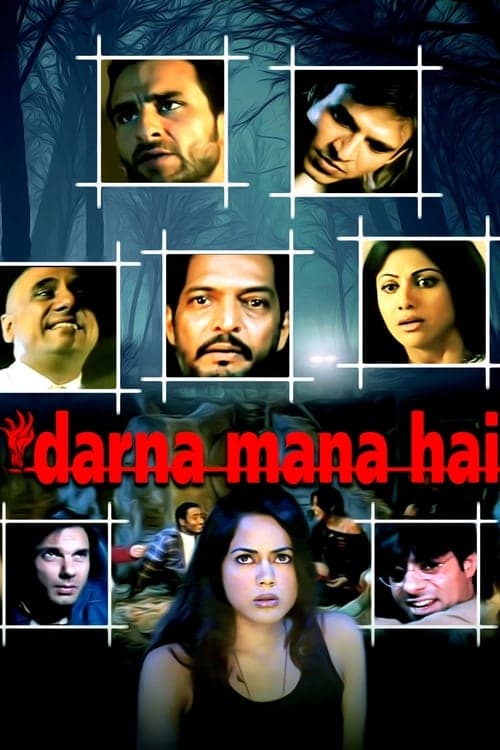
Darna Mana Hai (2003): Ending Explained
Darna Mana Hai ends by revealing its frame narrator as the killer and its surviving heroine as a ghost, collapsing the anthology's six stories into one…
8 min read
Release Year: 2003
Rating: 6/10
Runtime: 121 minutes
By Luna Sterling
The short answer
The short answer
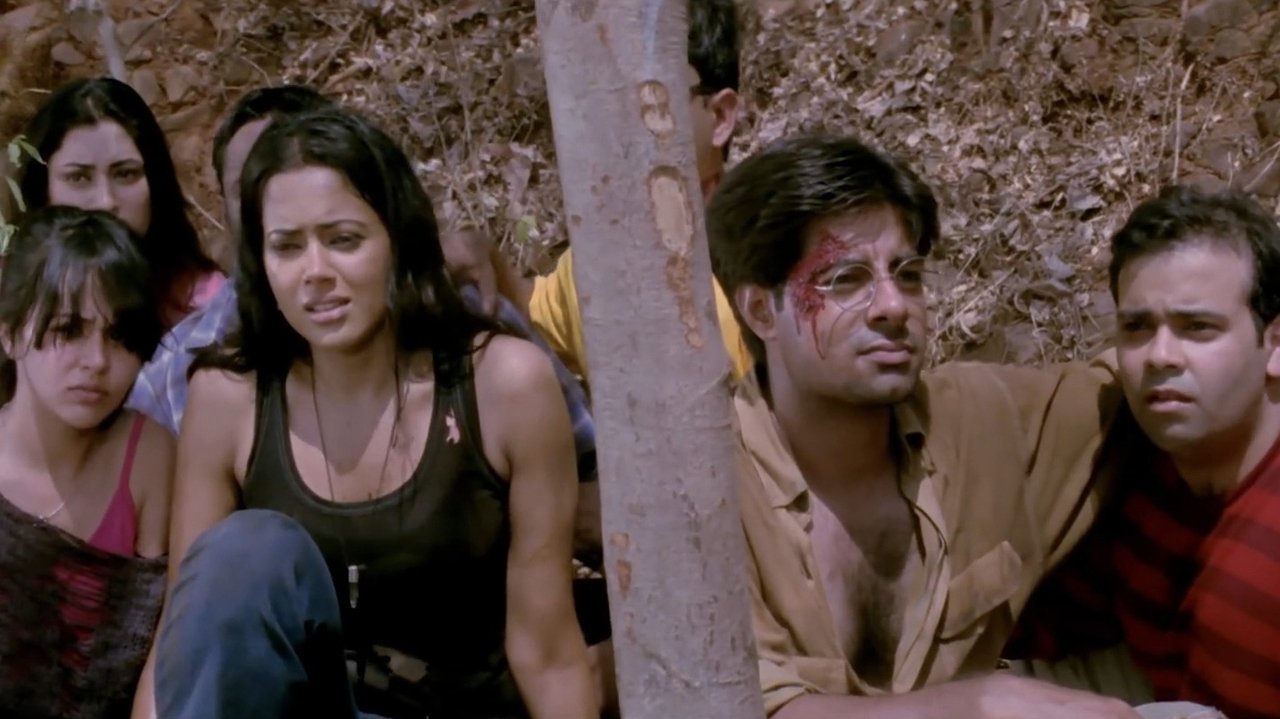
The stranger who sat down at Shruti and Suman's bonfire and asked to hear a story is the killer. He has been picking the friends off one by one all night, and he says so himself before he stabs Suman for being afraid. Then he catches Shruti and stabs her too. She wakes at dawn in a clearing full of police and ambulances, tries to tell them who did it, gets ignored, and only understands why when the killer points at a body on the ground and she recognises her own face. She is dead. So is he. So is everyone. Darna Mana Hai spends two hours promising you six ghost stories and ends by revealing that the seventh story was the one you were sitting inside.
The contract
The first act makes a deal, and it's a narrow one. Seven friends, a flat tyre, a ruined house, a bonfire. Vikas stays in the car. The others find signs that someone lives in the wreck. They sit down and take turns. What the film promises in that setup is an anthology with a light frame: the friends are the narrators, the six stories are the goods, and the question hanging over the night is whether anything out there in the dark is real. The shape you expect is a return to the frame at the end, a scare in the forest, maybe Vikas found dead, cut to credits.
The stories themselves hold up their end. 'On The Way' gives you Karan smirking into a rearview mirror that refuses to show him, while Anjali leans on an arm that isn't there. 'Ghostly Lift' gives you Amar dropping his sunglasses to show hollow eye sockets, then vanishing while John Rodrigues dies of shock. Every one of the six is a cruel little machine with a twist at the back. You settle in. You learn the rhythm: tell a story, get a jolt, come back to the fire.
And then, quietly, the frame starts breaking its own rules. Neha asks Romi to walk her to the car and he refuses, and she goes alone. Mehnaaz goes back for a blanket and is chased and stabbed by someone unseen, and her body turns up in the forest. Amar finds Vikas dead in the car with his neck slashed. After each story, one friend leaves the fire and doesn't come back. The anthology is eating its own narrators.
The breach
The breach is the newcomer. A man joins Shruti and Suman at the bonfire, claims he lives in the ruins, and asks to hear a story. Then he offers one of his own: seven friends, a car breaking down at night, a ruined shack, stories swapped until the friends are dead and only two remain.
Listen to what he's describing. That's the film. Not a story like the others. The film you've been watching, retold from the killer's side of the fire, and the two survivors in his version are Shruti and Suman, sitting right there.
He doesn't dress it up. He calls himself a genius, says he can't stand fear because it blocks progress, and says he'd kill anyone who's scared. Suman is scared. The man feels it on him and stabs him dead. Then he turns to thank Shruti for keeping her nerve, and she's already running. He catches her. He stabs her.
The story
The newcomer tells the frame back to Shruti and Suman as a tale, which means the film's own present tense is now one of its stories. The fire, the shack, the tyre: all of it gets demoted into anecdote.
The rule
He declares his criterion out loud, that fear gets you killed because it blocks progress, and then applies it to Suman on the spot. Whatever this man believes about himself, the rule is just the permission slip.
The stabbing
Suman dies. Shruti runs, gets caught, gets stabbed. The film's last two narrators are gone, and the audience has nobody left to stand behind.
The dawn
Shruti wakes at daybreak among police and ambulances, sees the killer sitting on a car, and tells the police he's the murderer. They ignore her completely.
The body
The killer points at a corpse. She recognises it as her own. The reason nobody hears her is that there's nothing to hear.
The company
He tells her there's nothing left to fear, since everyone is dead, including him. The ghosts of her friends arrive to join them.
The USPs of Darna Mana Hai are the sound quality and the scary moments that have been injected in the stories. Also, the length of most stories is concise, so boredom does not set in at all.
Why it does it
Here's the thing about sitting through six stories: you learn the twist. You learn to expect the ghost, the reincarnation, the corpse in the basement, the apple where the husband used to be. By the time Purab freezes himself in the mirror saying "stop," you know exactly what kind of film you're in and you're a step ahead of it.
The ending is the film catching up. The killer's whole complaint is that fear blocks progress, and an audience that knows the shape of every scare isn't afraid of anything. So the film kills its own narrators and makes the survivor a ghost, and the move that lands isn't the stabbing. It's the police walking past Shruti at dawn like she isn't standing there. You've spent the whole film being told ghost stories, and the last one is aimed at the person watching. The killer's confession, "everyone is dead, including himself," is the film admitting it has run out of people to frighten and is now frightening an empty room.
This is why Taran Adarsh called it a film for the intelligentsia rather than the average cinegoer, who "may find the concept of the film difficult to digest." That's not a knock on the audience. It's a description of the trick. A viewer who wanted six scares and a wrap-up gets instead a seventh story that rewrites the previous six as a script the killer was reading from. Varun's line in 'Homework' is the thesis of the whole film, laid in early: "You are not insane yet. But you will be." The stranger finishes the sentence.
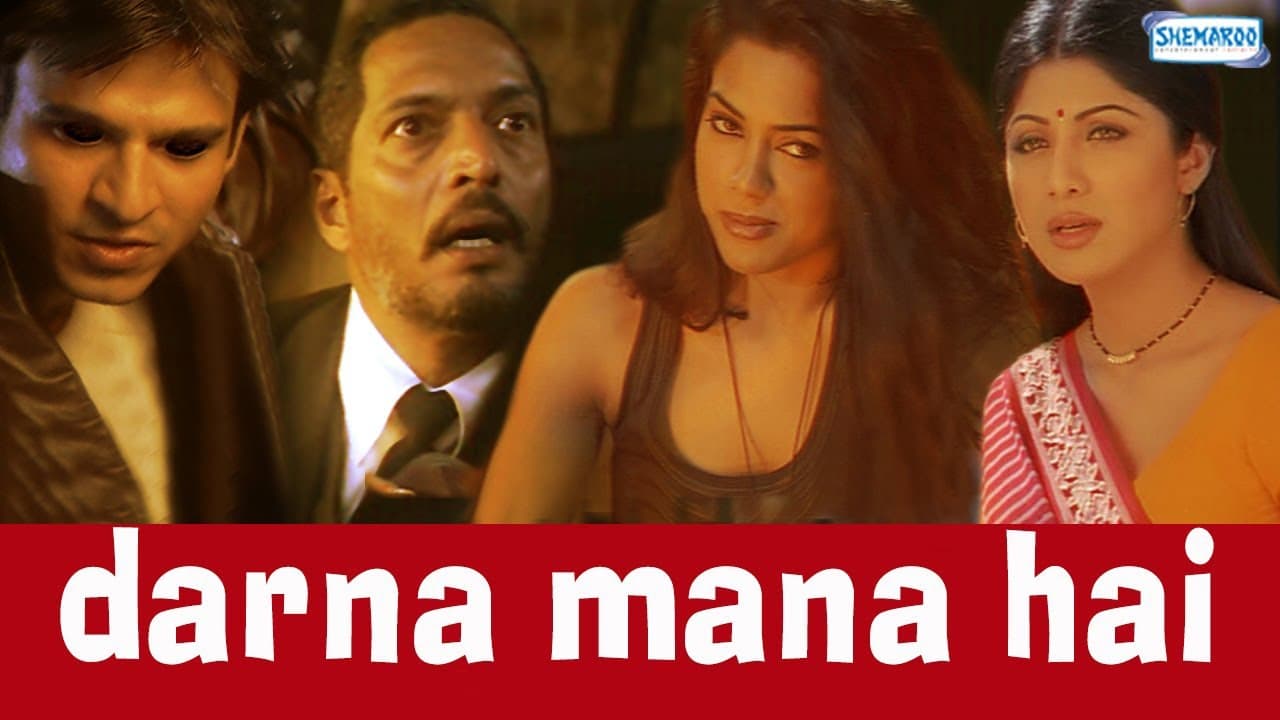
What the film becomes
Left: what it looks like. A Hindi horror anthology from the Ram Gopal Varma factory, six chillers and a wraparound, produced for 4.50 crore and sold on the star cameos. Aftab Shivdasani, Shilpa Shetty, Saif Ali Khan, Sohail Khan, Nana Patekar, popping up for a segment each. Fun-size horror, 121 minutes, music by Salim, Sulaiman, songs famously left out of the cut the way Bhoot left out its own.
Right: what it is. A film about the anthology form eating itself. The six stories stop being stories. They're the killer's pretext, and the friends aren't an audience, they're the body count. What looked like a frame around the tales turns out to be the last tale, and the heroine who should walk out of the frame at dawn turns out to have been a ghost for who knows how long, the same reveal that powered 'On The Way' and 'Ghostly Lift' but now aimed at the one person the film let stand in for us.
The verdict
The verdict
Darna Mana Hai is a mean film, and the meanness is the point. It gives you an anthology contract, honours every clause of it for six stories, then voids the whole thing by revealing that the frame was never a frame. The stranger at the fire is the killer because there was never anyone else at that fire worth being afraid of; Shruti is a ghost because the film's own rules about ghosts apply to her too, and it would be cheating for them not to. The final image of Shruti standing among the police who won't look at her, with the ghosts of her friends arriving to keep her company, is not a twist tacked on for a jolt. It's the film closing the loop it opened in act one, and it's the reason the six stories before it play, on a second watch, like testimony. Prawaal Raman built a haunted house and then revealed the audience was already inside it. You don't leave Darna Mana Hai. You get filed away in it, along with everyone else who was scared.