Upside Down (2012): Ending Explained
Adam trades his formula to save Eden, but Bob already owns the patent: the film ends with twins, two skylines and shared basketball.
7 min read
Release Year: 2012
Rating: 6.3/10
Runtime: 104 minutes
By Ending Explained Team
The short answer
The short answer
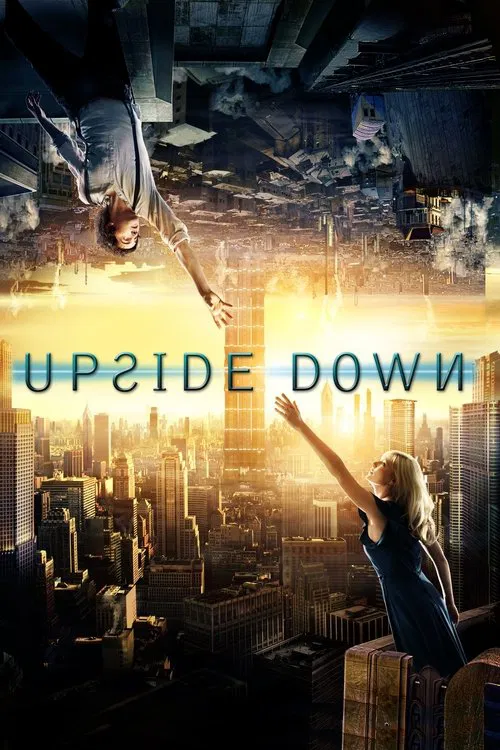
Adam survives the fall between the two worlds because of his inverse-matter vest. Trans-world agrees to drop the charges against Eden on two conditions: Adam hands over his formula, and he never contacts her again. He goes back to his old life in Down Below believing she's gone for good. Then Eden goes to Bob, Bob finds Adam and shows him he can stay in Down without any opposite-matter gear, using Adam's own methods to cancel gravity. Bob also tells him he bought the beauty-cream patent under the name "Albert and Co." before Trans-world could, and that Adam has a "date." Some time later, Eden is pregnant with twins, skyscrapers stand on both worlds, and kids from Up and Down play basketball together.
The rules, the vest, the way out
First: the laws
Early on, the film lays out three immutable laws of gravity for the two-planet system. Matter is pulled only by the world it comes from. Weight can be offset with matter from the opposite world. And after a few hours, matter touching inverse matter burns. These rules aren't decoration. They are the physics of the whole movie, and they are also the physics of the caste system: Up and Down can touch, but not for long, and not without damage.
The turn: the vest
At the mountain where they first met as children, the police close in and Eden is arrested. Adam falls the remaining distance between the worlds. He lives, and the reason is the inverse-matter vest. This is the motif's first real payoff: the thing that was supposed to burn him is the thing that saves him.
The ending: no accoutrements
Bob finds Adam and proves he can stay in Down without any opposite-matter gear at all, using Adam's methods to negate gravity outright. The vest was survival. This is something bigger. The law that said matter belongs to one world and burns on contact with the other has been worked around, not just survived. And the final image of the film, skyscrapers on both sides and children from both worlds playing basketball, is the same discovery applied to a civilization.
Where the motif breaks
The break isn't in the physics. It's in who controls it.
For most of the film, the formula is Adam's leverage against Trans-world: they cannot manufacture the cream without his withheld ingredient. They have the only official link between the worlds; the oil trade and the electricity markup belong to Up Top. He has one thing they need. That's the whole negotiation.
Then Bob tells Adam he bought the beauty-cream patent under the name "Albert and Co." before Trans-world did. That single line changes what kind of story this is. The formula was never going to be pried loose by a romantic gesture or a daring escape. It gets loose because someone filed the paperwork first. The motif of inverse matter resolves through a patent, which is a strange and very funny thing for a movie about two planets orbiting each other to do.
I'd argue that's the film's actual ending, and the pregnancy and the skyscrapers are the epilogue to it. Trans-world's power in this world runs on being the only official link between the worlds. Trans-world traded for a formula whose patent now sits with Bob, and Adam's methods no longer need their building. "Albert and Co." is the loophole. I'd argue that's why Trans-world's condition that Adam never contact Eden stops mattering: what they were trading for is no longer theirs to hold over him.
In spite of its wonderfully unusual premise and talented cast, Upside Down fails to offer much in the way of compelling drama to anchor its admittedly dazzling visuals.
What it adds up to
What you see the first time
Adam falls between the worlds and lives, but he loses Eden to a legal settlement. He goes home. The movie looks like it's heading for a tragic ending, and briefly it delivers one: charges dropped, contact severed, lovers separated by contract.
Then Bob shows up with a patent and a "date," and the whole thing reverses. The formula Adam was using as a hostage was already out of Trans-world's hands. The separation was never real. You were watching a reunion that had already been arranged.
What you see once it's over
:::divider:::
The rewatch changes the mountain scene. The first time, Eden's arrest and Adam's fall read as the cost of loving across the divide. The second time, you know the fall is survivable because the vest works, and you know the arrest is temporary, because Bob is waiting with the patent and a date. The scene plays as a crisis. It's a setup for the reversal.
The other thread
The film also settles Aunt Becky, or rather it doesn't, and that absence is doing work.
Adam's great-aunt is arrested and her home is burned early on, when he's still a kid. She's the one who holds the flying-pancakes recipe, the pollen from pink bees that gather from both worlds, the inherited cross-world knowledge that mirrors Adam's own cross-gravity formula. She holds the recipe meant for Adam, and then she's gone, and the movie never tells you what happened to her.
By the end, Adam has children on the way and a world remade by his formula; the patent itself sits with Bob. The recipe was supposed to pass to him. The film never goes back to Becky. I read that silence as deliberate: the film is about knowledge crossing a border, and Becky held knowledge drawn from both worlds, and she was arrested after the children's meeting was discovered. The film never revisits Becky's arrest.

The verdict
The verdict
This is a movie that critics mostly dismissed for putting its budget into the look and not the story. Lewis Wallace at Wired put it plainly: "If only the story were as original, or as strong, as the film's topsy-turvy look. Unfortunately, Upside Down...invests almost all of its cinematic capital in gravity-defying eye candy." Frank Scheck at The Huffington Post found the film confusing, a "head-scratcher" whose "logistical complexities and heavy-handed symbolism ultimately prove off-putting." Mick LaSalle at the San Francisco Chronicle was kinder to the frame and harder on the contents: "The only problem is that, after creating the most wonderful fantastic frame, Upside Down doesn't devise a picture worthy of it."
They're not wrong about the frame. But the ending they mostly didn't credit is the one place the film gets its own premise. Adam trades his formula to save Eden, but Bob already owns the patent: twins, two skylines, shared basketball. The Romeo-and-Juliet setup promises a tragedy, and the film refuses it, not with a rescue or a sacrifice, but with a patent held under the name Albert and Co. and a man telling his friend he has a date. That's a weirder, more specific ending than the premise deserves. The formula's payoff was never just cosmetic. It makes the Down world rich enough to build its own skyline, and it puts kids from both sides on the same basketball court.
That's the whole argument of the movie in one image, and it's an argument the film mostly earns in its ending. The romance is thin. The physics is muddled. The politics, as Stephen Whitty at The Star-Ledger noted, are blunt: the upper world "has been getting fat exploiting the resources of the lower one." But the resolution isn't love conquering all. It's a loophole, a patent, and a generation that doesn't need the vest. I'll take that over a balcony scene.