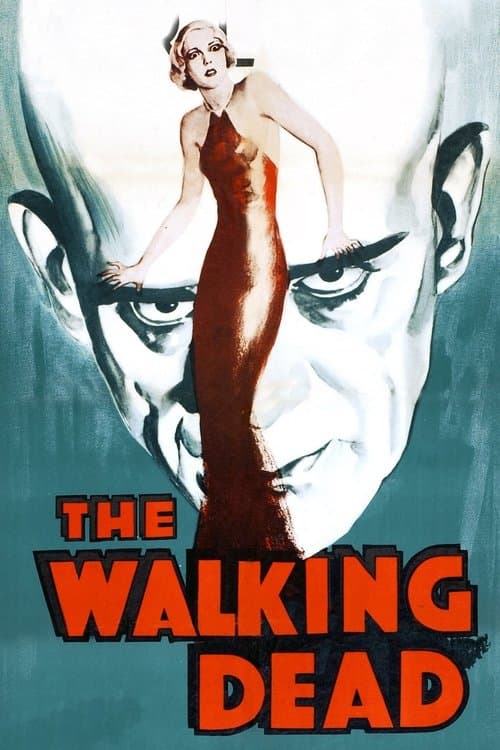
The Walking Dead (1936): Ending Explained
"HE DIED a man with a hunger to love... and returned a monster with an instinct to kill."
Down-on-his-luck John Ellman is framed for a judge's murder. After he's convicted and sentenced to death, witnesses come forth and prove his innocence. But it was too late for a stay to be granted and Ellman is executed. A doctor uses an experimental procedure to restore him to life, though the full outcome is other than expected.
9 min read
Release Year: 1936
Rating: 6.223/10
Runtime: 66 minutes
By Luna Sterling
The Walking Dead (1936): Ending Explained
In the shadowy underbelly of 1930s crime thrillers, The Walking Dead (1936) stands out as a chilling blend of injustice, resurrection, and supernatural retribution. Directed by Michael Curtiz, this pre-Code horror-tinged drama stars Boris Karloff as the wronged everyman John Ellman, whose journey from the electric chair to vengeful phantom probes the fragile line between life, death, and moral reckoning. If you're searching for a deep dive into the film's haunting finale—where guilt manifests as a palpable fog of dread—this ending explained will unravel its literal events, symbolic layers, and lingering ambiguities. We'll explore how the conclusion ties into the story's pulse of tension and psychological torment, leaving you with that uneasy chill long after the credits roll.
Quick Recap
John Ellman, a down-on-his-luck musician fresh from a decade in prison, stumbles into a web of corruption when he's hired to tail Judge Roger Shaw, a stern figure who's just sentenced a racketeer to hard time. What begins as a simple surveillance gig spirals into nightmare: Shaw is gunned down in his car, and Ellman, arriving at the crash site, is framed as the killer by the very gang seeking revenge on the judge. The trial is a farce—riddled with incompetence and bias—and despite last-minute witnesses proving his innocence, Ellman is rushed to the electric chair, his life extinguished in a haze of flickering lights and final, desperate pleas.
Enter Dr. Evan Beaumont, a scientist obsessed with the mysteries of death and the soul. With the help of his young associates, Nancy and Jimmy, Beaumont claims Ellman's body for an experimental revival, pumping it full of electricity and elixirs in a dimly lit lab that hums with the low throb of forbidden ambition. Ellman awakens, not as the man he was, but as something altered—his skin pale and drawn, his eyes holding a distant, knowing gleam. No longer bound by ordinary fears, he senses the guilt of his framers: the racketeers Trigger, Blackstone, Merritt, and the shadowy others. One by one, he seeks them out, not with violence, but with a presence that stirs their consciences into fatal frenzy. Trigger's hand trembles on his gun until it backfires; Blackstone flees into the path of a roaring train; Merritt clutches his chest and plummets from a window. As the noose of retribution tightens, Ellman vanishes into the night, drawing the story toward its fog-shrouded climax in a cemetery where the air hangs heavy with the scent of damp earth and unspoken sins.
What Happens in the Ending
The film's final act unfolds in the moonlit hush of a cemetery, where the wind whispers through crooked headstones like a collective sigh from the grave. John Ellman, his figure gaunt and spectral under the pale glow, wanders among the tombs, evading the pull of the living world. Nancy, the compassionate assistant to Dr. Beaumont, stumbles upon him there—her footsteps crunching softly on the gravel paths, her breath catching in the chill air as she pleads for him to return, to reclaim some semblance of normalcy. But Ellman remains elusive, his voice a low murmur laced with otherworldly detachment, as if the veil between worlds has thinned around him.
As Nancy hurries off to fetch Beaumont, the two surviving racketeers—Lanning and Nolan, guardians of the conspiracy—track Ellman down in a desperate bid to silence him forever. Gunshots crack through the night, sharp and echoing like thunder in the confined gloom of the gravekeeper's cottage. Ellman collapses, blood staining the rough wooden floor, his body crumpling in a pool of shadow. Beaumont arrives in a frenzy, kneeling beside the dying man amid the flickering lantern light that casts long, wavering silhouettes on the walls. Pressed for revelations about the afterlife—has he glimpsed the soul's secrets?—Ellman musters his final strength to deliver a solemn rebuke, quoting Deuteronomy 6:15: "Leave the dead to their maker. The Lord our God is a jealous God." His eyes dim, his breath rattles into silence, and the room falls into a profound, oppressive quiet.
In a final twist of ironic justice, as Ellman's spirit departs, the racketeers' getaway car careens wildly down a rain-slicked road. Tires screech against the wet pavement, headlights cutting through the darkness like accusatory beams. The vehicle slams into an electric pole with a deafening crash, sparks erupting in a visceral burst of fire and electricity—mirroring Ellman's own execution. The explosion engulfs them in flames, their screams lost to the roar. The screen fades as Beaumont, alone with the echo of Ellman's words, repeats the biblical warning, his face etched with the weight of what he's unleashed.
The Meaning Behind the Ending
At its core, the ending of The Walking Dead serves as a visceral meditation on divine retribution and the inescapability of guilt, where the resurrected Ellman becomes an unwitting instrument of cosmic balance. The cemetery confrontation isn't mere chase; it's a psychological siege, the air thick with the unspoken terror of facing one's buried sins. Ellman's revival, born from Beaumont's hubris, twists the scientist's quest for knowledge into a cautionary tale: tampering with death invites a jealous God's wrath, as symbolized by the explosive finale that electrocutes the guilty in a hellish echo of the chair. The racketeers' deaths aren't inflicted by Ellman's hand but bloom from their own festering consciences—guilt manifesting as trembling fingers, panicked flights, and fatal missteps—underscoring the theme that true punishment is internal, a slow poison seeping through the soul.
This climax reinforces the film's undercurrent of moral ambiguity in a corrupt world: Ellman's innocence is proven too late, mirroring the era's frustrations with flawed justice systems, yet his return amplifies the tension between human frailty and supernatural inevitability. The sensory pall of the ending—the metallic tang of blood, the acrid smoke of the crash—heightens the mood of dread, leaving viewers to ponder if Ellman's warning is a rejection of scientific overreach or a plea for humility before the unknown.
Character Arcs and Resolution
John Ellman's arc culminates in tragic transcendence, evolving from a passive victim of circumstance—framed and fried by a system that chews up the vulnerable—to a spectral avenger whose mere presence unravels evil. His final moments in the cottage strip away any illusion of revenge; instead, he achieves a quiet apotheosis, dying not in rage but in wisdom, his biblical admonition marking a return to purity. For Ellman, resolution comes in release—back to the maker he invokes—closing his circle from wrongful death to rightful peace, though laced with the psychological scar of his unnatural limbo.
Dr. Beaumont's journey, driven by intellectual curiosity, resolves in humbled awe. His experiment succeeds technically but fails ethically, forcing him to echo Ellman's words like a mantra of regret. The young lovers, Nancy and Jimmy, represent untouched innocence; Nancy's cemetery plea highlights her arc toward empathy, while Jimmy's silence underscores the cost of complicity. The racketeers, archetypal villains of greed, meet poetic ends that resolve their arcs in self-destruction—Nolan's guardianship turning to betrayal, Lanning's flight to fiery doom—illustrating how corruption devours itself when confronted by unyielding truth.
Alternate Interpretations
The ending's ambiguity invites multiple lenses, particularly around Ellman's supernatural aura. One reading casts him as a genuine zombie-like revenant, his "innate sense" a literal gift from beyond, making the racketeers' deaths divine justice rather than coincidence— the jealous God acting through him, with the car explosion as heavenly lightning. Alternatively, a psychological interpretation sees Ellman's presence as a hallucination born of the guilty's paranoia; their "horrible deaths" stem from unraveling minds, not otherworldly forces, turning the film into a study of conscience as the true undead horror. The biblical quote could support either: a literal warning against resurrection or a metaphor for guilt's corrosive power. For some, Beaumont's repetition suggests scientific skepticism yielding to faith, while others might view it as his denial, perpetuating the cycle of forbidden knowledge. These layers keep the tension alive, blurring horror with human frailty.
Themes and Symbolism
The ending amplifies The Walking Dead's core themes of injustice and redemption, subverting the zombie trope by making Ellman a sympathetic "walker" whose undeath symbolizes the lingering wounds of societal wrongs. Electricity recurs as a potent symbol— from the chair's lethal jolt to the lab's revival and the final explosive pole—representing both destruction and illicit rebirth, a visceral reminder of technology's double-edged blade in an age of rapid change. The cemetery, with its earthy chill and echoing silence, embodies the theme of the soul's journey, contrasting the living world's clamor with death's jealous solitude.
Guilt emerges as the film's shadowy antagonist, a psychological fog that chokes the air and drives fatal actions, reinforcing how unconfessed sins fester like open graves. Biblical undertones subvert secular ambition, portraying science as a jealous rival to faith, while the racketeers' fiery end evokes hellfire, symbolizing retribution's inevitable blaze. Overall, the conclusion reinforces a moral universe where the dead demand accounting, heightening the film's atmospheric dread without resolving into tidy catharsis.
Final Thoughts
The Walking Dead's ending masterfully weaves visceral horror with profound introspection, delivering a finale that lingers like the damp mist of its cemetery scenes—unsettling, inevitable, and richly interpretive. By letting guilt be the executioner and capping it with Ellman's poignant warning, the film avoids cheap thrills, instead crafting a tense psychological payoff that critiques blind ambition and celebrates quiet moral victory. It works brilliantly for its era, blending Karloff's haunted gravitas with Curtiz's moody visuals to create an enduring chill. If justice feels delayed in our world, this 1936 gem reminds us: the dead have a way of rising, and their reckoning is as explosive as it is inescapable. For fans of atmospheric classics, it's a must-revisit that rewards with layers of shadowy depth.