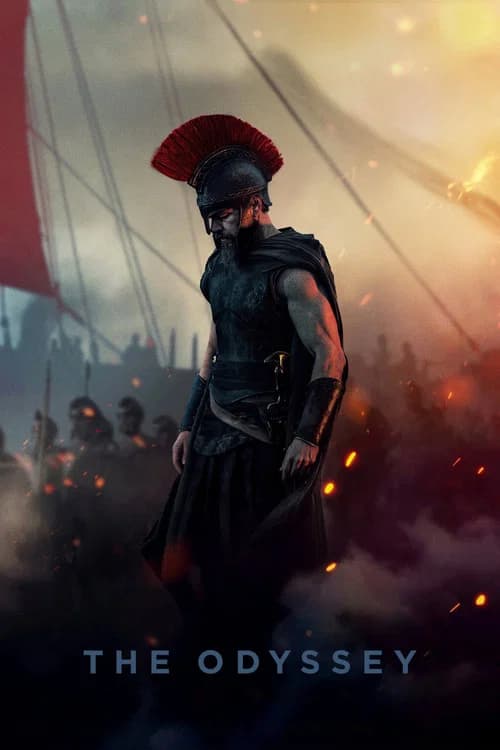
The Odyssey (2026): Ending Explained
Odysseus gives Ithaca to Telemachus and sails into exile with Penelope, paying for his homecoming with everything he killed for.
7 min read
Release Year: 2026
Rating: 8/10
Runtime: 173 minutes
By Ending Explained Team
The short answer
The short answer
Odysseus is the one who pays. Nolan's Odyssey ends not with a restored king but with an abdication: the man who spent twenty years clawing his way back to Ithaca gives the island to Telemachus and sails west with Penelope into exile. The price is everything he killed for, and the film argues the price is fair, because the homecoming was never the crime's reward. It was the crime's last stop. What he's buying with the throne is the only thing left that isn't bloodstained: a chance to leave before the debt collectors arrive.
The last twenty minutes
The disguise holds until the dog
Odysseus, washed ashore under the alias "Sinon," rescues Telemachus from the bandits the suitors sent to kill him. Mentor is already dead. Then Argos, the old dog, recognizes him and dies. Telemachus puts the pieces together. The cost is immediate: the moment his identity surfaces, so does every lie attached to it, starting with the name he borrowed from a man he sacrificed at Troy.
The confession
At the feast Odysseus confronts Antinous about betraying Sinon. Antinous thrashes him. Telemachus steps in. After the meal, still disguised, Odysseus tells Penelope the truth: he desecrated Athena's statue, killed her priestess, triggered the Late Bronze Age collapse, and the "Sea Peoples" she feared were the Greeks themselves. He begs for forgiveness. This is the film's real wound, and it costs him the last shred of the hero story he rode in on.
Penelope sets the contest
She announces she'll remarry and tells the suitors to come back at dawn. String Odysseus's bow, shoot an arrow through a row of axe heads, and she's yours. She isn't testing them. She's building a trap only one man alive can spring, and she knows it.
The shot
Every suitor fails. Odysseus succeeds. The bow does what no disguise could: it announces him. The hall erupts. He and Telemachus cut down the challengers, Antinous among them. The cost is that his homecoming arrives as a massacre, and Ithaca gets its king back standing over a pile of noble corpses.
The abdication
The surviving suitors surrender. Odysseus cedes the throne to Telemachus and leaves with Penelope to seek peace in exile. He wins the fight and hands over the prize. The cost is the crown itself, and the version of himself that needed it.
West
Sailing west to honor his fallen soldiers, the couple talk about civilization renewing itself. They muse that time will forget Odysseus's mistakes. The cost is buried in that hope: forgetting is the only mercy on offer, and it isn't forgiveness.
The ledger
What they gain
Odysseus gets his name back, a son who fights beside him, and a wife who leaves the island with him.
What they pay
Odysseus pays the throne, the crown, and any claim to being the man the myth built. He trades Ithaca for exile and asks time to erase what he did.
Telemachus gains the throne of Ithaca, uncontested, and a father who finally stood in the room with him.
Telemachus pays with Mentor, killed by the suitors' bandits before the rescue, and with the knowledge of exactly what his father is.
Penelope gains the truth, the whole confession, and a husband who chose her over the kingdom.
Penelope pays by leaving the home she defended for twenty years and betting her remaining life on a man who just admitted he broke the world.
Antinous gains nothing.
Antinous pays with his life in the hall, killed by the man he thrashed at the feast.
Sinon isn't in this ledger as a living party. His shade already reproached Odysseus in Hades, and his name is the one Odysseus wears when he comes home. The dead are the creditors here, and they don't get repaid. They get honored, which is cheaper.
The irony
Penelope gets exactly what she wanted: she married the only man who could string the bow, and she got the truth out of him first. It isn't the outcome she wanted it to be. For twenty years she held the house against suitors and Sea Peoples on the promise that Odysseus would return and everything would snap back into place. What returns is a man who confesses that the Sea Peoples were the Greeks, that he desecrated Athena's statue, that he killed her priestess. She wins the contest and loses the ending she'd been defending. Her prize is a husband she has to leave home to keep.
Odysseus gets the recognition he bled for. Argos dies the instant he's seen. Telemachus knows him. The bow announces him. Every recognition scene in the last act is a door closing, not opening. He wanted to come home and be known. He's known, and being known means being the man who did all of it. So he does the one thing that isn't a reenactment of Troy: he hands the kingdom to his son and walks away from the throne he spent two decades surviving to reach.
Did anyone get a warning
Tiresias, in Hades, told him outright: by divine will, only Odysseus would return home. Not the crew. Not the army. Him. Alone. The film plants that line early and lets you forget it, because it sounds like a promise. It's a bill. Every man who dies between that prophecy and the bow contest is the interest on it.
Nolan and his collaborators have constructed a strange, fearsome and trailblazing machine of a movie, by some distance, the best of the year so far.
The second warning is the one Odysseus gives himself. On Thrinacia he tells his men not to touch the cattle of Apollo because Tiresias said they'd die if they did. They're starving. They disobey. Zeus sinks the ship and kills all but Odysseus. He knew the price, said it out loud, and paid it anyway. That's the whole film in one beat: a man who can see the cost and still can't stop the men around him from choosing it. By the end there are no men around him. Only Penelope, and a westward horizon, and the hope that time does the forgiving he can't.
The verdict
The verdict
The ending is a bill coming due, and the film says the price is fair. Odysseus doesn't reclaim Ithaca because reclaiming it would mean becoming Agamemnon, and Agamemnon's shade already showed him what waits at the end of that road: a wife with a knife and a daughter sacrificed for fair winds. So he pays the only currency he has left. He gives Telemachus the throne, gives Penelope the truth, and gives the dead the westbound voyage. What he keeps is time, and the film is honest that time isn't absolution. It's just distance. Nolan builds a 173-minute, $250 million machine around a homecoming and then lets his hero walk away from the thing he came for, which is either the most subversive blockbuster ending in years or the only one that could possibly be true. Odie Henderson called it sinking "under its bleakness like a lead balloon." He's reading the same ending I am. He just thinks the price is too high. I don't. Odysseus spent twenty years learning that you can't come home without bringing the war with you, and the last shot is him finally agreeing.