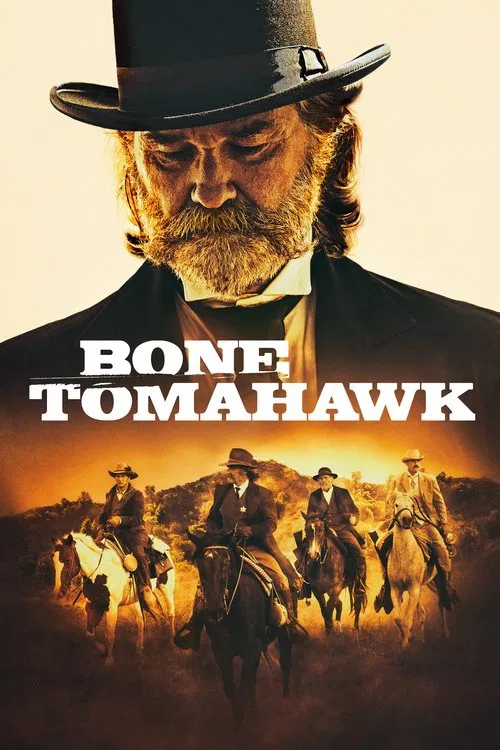
Bone Tomahawk (2015): Ending Explained
Mortally wounded, Sheriff Hunt stays behind to kill the last three troglodytes. Arthur, Samantha and Chicory escape; three distant gunshots follow.
7 min read
Release Year: 2015
Rating: 6.9/10
Runtime: 133 minutes
By Ending Explained Team
The short answer
The short answer
Sheriff Franklin Hunt stays behind, mortally wounded, with a rifle. He's been cut open and shot by the troglodytes, and he promises to kill the remaining three troglodyte males when they return, so they can never terrorize Bright Hope. Arthur, Samantha, and Chicory make it out of the valley, passing two pregnant troglodyte women whose limbs have been amputated and whose eyes have been staked blind. Once they're clear, Arthur blows the troglodyte bone whistle and gets nothing back. Later, three gunshots sound in the distance. Three is the number Hunt promised. Either the shots are him finishing the job or dying in the middle of it. The film never shows which.
How the ending plays out
Arthur finds the trail
The party left Arthur behind when his leg worsened; he followed their trail on foot and now catches up in the worst way: alone, into a valley that has already killed Brooder and eaten Purvis and Nick. He kills two troglodytes and discovers they use crude animal bone whistles to communicate. He turns that discovery into a tactic, luring a third troglodyte to its death. Arthur stops being a man who limps after his wife and becomes a man who sets traps. He's good at it.
The cave
Arthur reaches the cave and helps Hunt kill the troglodyte leader, then frees Samantha and Chicory. This is the rescue the whole film has been promising, and it arrives late, small, and ugly. It takes the last of Hunt's body: he's already been cut open and shot by this point, and the fight is the final thing he has. I'd say it plays as cleanup, not triumph.
Hunt stays behind
Hunt is mortally wounded and stays anyway. He tells them he'll stay with a rifle and kill the remaining three troglodyte males when they return, so the tribe can't terrorize Bright Hope. This is the actual ending of the film, not the shootout. A man who is already dead decides what his death is for. He gives up everything left on the table: his town, his job, his life past this cave.
The walk out
Arthur, Samantha, and Chicory leave. On the way they pass two pregnant troglodyte women whose limbs have been amputated and whose eyes have been staked blind. Nobody kills them. Nobody frees them. The survivors just walk past. This is the image the film leaves you with, and it's the one that complicates every clean reading of who the monsters were.
The whistle
Clear of the valley, Arthur blows the troglodyte bone whistle. No response comes back. I'd read the whistle as a test for anything following them; the film doesn't settle it. He's learned their language well enough to use it. The tool of the thing that took his wife is now the tool he uses to listen for what's behind them.
Three shots
Later, three gunshots in the distance. Three is the number Hunt promised: the remaining troglodyte males. The film doesn't show what happened. It gives you the count and then it ends.
The ledger
What they gain
Arthur O'Dwyer gets his wife back, plus the kills the valley demanded: two troglodytes and one lured to its death.
What they pay
Arthur O'Dwyer pays with his body. His leg wound is worse by the end, and he walks out of the valley having done things he can't undo. He also pays by walking out and leaving Hunt behind in that cave.
What they gain
Samantha O'Dwyer survives. She's the reason the rescue party rode out in the first place, and she's one of three people who walk away.
What they pay
Samantha O'Dwyer pays by watching Nick get scalped, bisected alive, and eaten while she's held in the same cave. She also walks past the blinded troglodyte women. She gets out. She doesn't get out clean.
What they gain
Chicory survives, and he does it as the deputy who was never the hero of the party.
What they pay
Chicory pays by losing his sheriff; the film ends before anyone reaches Bright Hope, and he watched Hunt make that choice.
What they gain
Sheriff Franklin Hunt gets the ending he chose: a rifle and the three remaining males to face before they can reach Bright Hope.
What they pay
Sheriff Franklin Hunt pays with his life, after being cut open and shot. He doesn't get a funeral on camera. He gets three gunshots in the distance.
The irony
Hunt spends the whole film as the man trying to bring everyone home. He organizes the rescue party, he keeps Chicory and Brooder moving, he takes responsibility for a town that mostly needs him to be steady. What he wants is for Samantha to be rescued and for the thing that took her to be stopped. Samantha is rescued, and the three distant shots suggest he did the rest. He just does it by not coming back.
The irony isn't that he dies. It's that the only way he can protect Bright Hope is to stop being in it. The man whose whole function was to be present, to show up with a badge and a rifle and a plan, has to be gone for the plan to work. And the film doesn't give him a hero's send-off to make that easier. It gives him a cave, a gut wound, and a promise. Then it gives you three gunshots and moves on to the survivors. The ending treats his death as something already decided, not a tragedy that needs staging.
Did anyone get a warning
You can see this coming in the opening interrogation, when Hunt shoots the fleeing Purvis in the leg, then sends Brooder to fetch the doctor. Hunt's instinct from minute one is to solve a problem by hurting someone and then dealing with the consequences later. He does it to Purvis, and by the end he's doing it to himself: taking the wound, staying behind, accepting that the harm lands on his body so the town doesn't have to carry it.
Brooder's "Smart men don't get married" is the closest thing in the film to a thesis about what these men are willing to lose. Brooder, who says it, dies in the valley. Hunt, who doesn't, stays behind in the cave. Arthur, who married anyway, is the one who walks out with his wife. The line lands differently by the end than it does when Brooder first says it, and the film doesn't underline the shift. It just lets you remember it.
Zahler has said he wrote it to reflect his own disinterest in marriage, which is worth knowing only because it tells you the line isn't moralizing. It's just true of the man saying it, and it turns out to be true of the men around him in ways they didn't sign up for.
The verdict
The verdict
Hunt comes out of this worse off than anyone, and the film thinks he earned it. Not as punishment, and not as some grand moral accounting, but because Hunt is the kind of man who puts himself between the danger and the town every single time, and the film follows that logic to its end. He doesn't die because he made a mistake. He dies because staying behind is what he does.
What makes it land is that Bone Tomahawk refuses to make his death bigger than it is. Guy Lodge, writing for Variety, praised the film's "wayward digressions of Zahler's script" as its "most treasurable" quality. I'd argue the ending works the same way: it stops, it counts three shots, and it lets the survivors walk out. The film's position is that Hunt gave what he had and the town gets to keep existing. Whether that's a good trade is a question the film answers by not asking it.