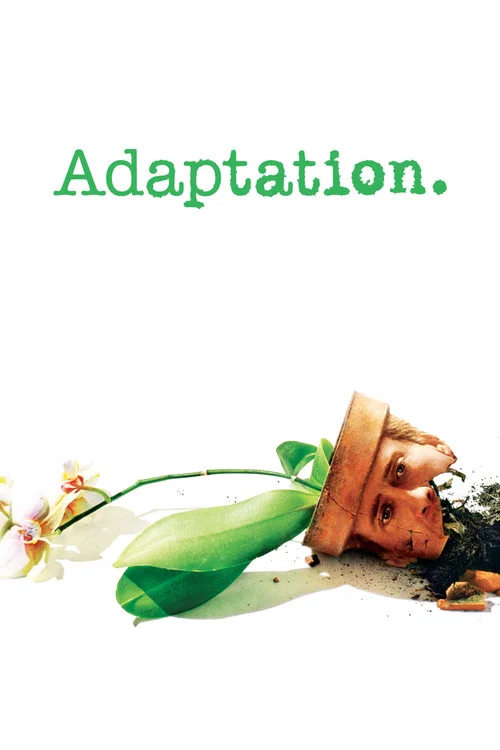
Adaptation. (2002): Ending Explained
At the end of Adaptation, Orlean holds Charlie at gunpoint, Donald dies, an alligator kills Laroche, and Charlie finishes the script full of hope.
7 min read
Release Year: 2002
Rating: 7.3/10
Runtime: 115 minutes
By Ending Explained Team
The short answer
The short answer
Susan Orlean forces Charlie Kaufman into the swamp at gunpoint to kill him. Donald Kaufman overpowers her and the brothers escape into the swamp, reconciling. The next morning, John Laroche accidentally shoots Donald. Charlie and Donald drive off in Orlean's car, collide with a ranger's truck, and Donald is ejected through the windshield and dies moments later while Charlie is saved by the airbag. Laroche is killed by an alligator before he can kill Charlie. Orlean is arrested and Charlie is cleared. Charlie reconciles with his mother, tells Amelia he loves her and Amelia responds that she loves him too, and finishes the script, ending with a voice-over announcing the script is done and that he is, for the first time, filled with hope.
That is the ending. It is also the joke, and the joke is on Charlie.
The last twenty minutes
The discovery
Charlie and Donald follow Orlean to Florida, where she meets Laroche. Charlie watches the two of them take the ghost orchid drug and have sex, and Orlean catches him. She decides he has to be killed so he can't expose them, and Laroche disagrees. Orlean's last claim to being the author of the book Charlie wanted to adapt faithfully is gone.
The drive
Orlean puts a gun on Charlie and makes him drive into the swamp. Donald, who followed them, overpowers her as she exits the car and escapes with Charlie into the swamp. The film's central premise, that a man who rejects formulaic scriptwriting is writing a movie that refuses to use it, just got a gun and a car crash.
The reconciliation
In the swamp, the brothers make up. Donald, the freeloader whose cliché spec script sells for a fortune, is the one who saved him. I'd argue Charlie's sense of himself as the serious artist doesn't survive the scene.
The shot
The next morning they try to escape. Donald accidentally wakes Laroche, and Laroche accidentally shoots Donald. Nobody in this scene means to do what they do. Donald's life is gone, and so is any reading of the ending as earned rather than handed to Charlie by coincidence.
The crash
Charlie and Donald drive off in Orlean's car and collide with a ranger's truck. Donald goes through the windshield and dies. Charlie is saved by the airbag. Laroche spots Charlie in the swamp but is killed by an alligator before he can kill Charlie. Orlean is arrested and Charlie is cleared.
The ledger
What they gain
Charlie Kaufman gets the script finished. He gets his mother back. He gets Amelia to say she loves him. He gets cleared of wrongdoing and survives. He gets, in his own voice-over, hope.
What they pay
Charlie Kaufman pays with his brother. Donald dies in the crash, after saving Charlie's life, and the script Charlie finishes is the one built on that death. He wanted to write something true and he wrote The 3 with orchids.
What they gain
Donald Kaufman gets to be the hero of the third act. He overpowers Orlean, he escapes with Charlie into the swamp, he reconciles with Charlie in the swamp.
What they pay
Donald Kaufman gets shot by a man he accidentally woke up, thrown through a windshield, and killed, and the film is dedicated to him. Donald gets what he wanted and dies before he can use it.
What they gain
Susan Orlean gets caught. She gets arrested. She is, at least, no longer pretending.
What they pay
Susan Orlean pays for the orchid drug, the affair, and the decision to kill Charlie with her freedom and with the version of herself she wrote in The Orchid Thief. The woman who wrote about an orchid thief ends up arrested over one.
What they gain
John Laroche gets to keep his obsession. He gets the ghost orchid, the drug, and Orlean.
What they pay
John Laroche pays with his life to an alligator, in a swamp, in the middle of a movie he was not told he was in. He dies as a plot device, which is the exact thing Charlie spent the film refusing to write.
The irony
Charlie wanted to make something that wasn't The 3. Donald wrote The 3 and sold it for six or seven figures. Charlie spends the whole film rejecting formulaic scriptwriting. Then he writes a third act with a gun, a car crash, a swamp, a death, an alligator, a love interest who loves him back, and a voice-over about hope.
Wesley Morris, writing in The Boston Globe, called the climax "the portion that either sinks the entire movie or self-critically explains how so many others derail," and described it as "bananas." He is right that it is one of those two things. The evidence says it is the second. The film doesn't accidentally become the movie Charlie hates. It becomes that movie on purpose, and then has Charlie narrate his own satisfaction over the top of it. The hope in the final voice-over is real within the fiction and damning outside it. He got the girl, he got the ending, he got the career. He got it by becoming Donald.
That is what the film means by an adaptation. Not the book into a movie. The artist into the hack.

Did anyone get a warning
The news that Donald's spec script sold for six or seven figures surprises Charlie. He has just been shown that the thing he refuses to do is the thing that works. I'd argue he treats it as evidence that the world is stupid rather than as a warning about where his own script is heading. It isn't a warning he misses. It's a warning he reads backwards.
"Too smart to ignore but a little too smugly superior to like, this could be a movie that ends up slapping its target audience in the face by shooting itself in the foot."
Clark wrote that about the film. It fits Charlie better. He is too smart to ignore and too smug to like, and the ending shoots him in the foot and calls it a happy ending.
The verdict
The verdict
Donald comes out of this ending worse off, and he did not deserve it. He moves in, takes up screenwriting, and writes a spec script that sells. He gets the money and the credit and dies before he can collect his brother's respect, and the film dedicates itself to him, which is the closest thing to an apology Charlie ever makes. Laroche and Orlean pay for what they did. Charlie pays with Donald, and the film lets him keep the hope anyway.
I think that is the point, and I think it is a cruel one. The last voice-over is not ironic because Charlie is lying. It is ironic because he is telling the truth. He really is hopeful. He really did finish the script. And the script he finished is the one Donald would have written, if Donald had lived long enough to write it. Roger Ebert, in the Chicago Sun-Times, said the film "leaves you breathless with curiosity, as it teases itself with the directions it might take." The direction it takes is the one Charlie swore he would never go, and the film watches him go there with a straight face and a happy ending, and dares you to call it a sellout. It is one.