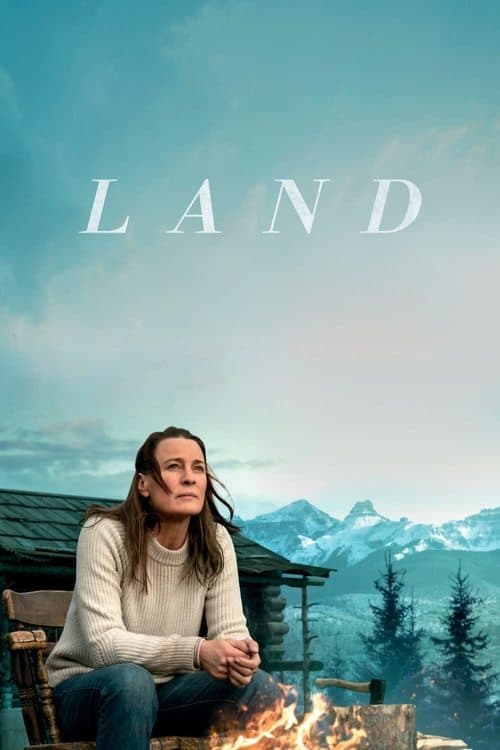
Land (2021): Ending Explained
"A story of humanity, in the face of uncertainty"
Edee, in the aftermath of an unfathomable event, finds herself unable to stay connected to the world she once knew and in the face of that uncertainty, retreats to the magnificent, but unforgiving, wilds of the Rockies. After a local hunter brings her back from the brink of death, she must find a way to live again.
8 min read
Release Year: 2021
Rating: 6.715/10
Runtime: 89 minutes
By Ellis Carver
Land (2021): Ending Explained
In Robin Wright's directorial debut Land, the raw beauty of the Wyoming wilderness serves as both a sanctuary and a mirror for profound personal turmoil. Starring Wright as Edee Holzer, the film delves into the quiet devastation of grief, exploring how isolation can either shatter or rebuild a fractured soul. As viewers search for a "Land ending explained," this article unpacks the film's poignant conclusion, revealing layers of emotional depth and thematic resonance. We'll break down the literal events, symbolic undertones, and the moral complexities that make this ending a subtle triumph in cinematic storytelling.
Quick Recap
Edee Holzer, a woman shattered by an unimaginable loss, abandons her urban life for the unforgiving isolation of a remote Wyoming cabin. Haunted by the random shooting that claimed her husband Adam and young son Drew at a concert hall, Edee seeks solitude to escape the world's unbearable empathy and her own unrelenting pain. In therapy sessions before her departure, she confesses her aversion to human connection, believing it's unjust for others to share her suffering. Arriving at her new home without modern amenities—no phone, no car—she dives headfirst into self-reliance, but the wilderness proves merciless.
Edee's early days are a brutal trial: she fumbles with chopping firewood, fails at fishing, and cowers in terror as a black bear ravages her supplies. Starvation and despair push her to the edge; she sights a deer but can't pull the trigger, and in a moment of utter defeat, she raises her rifle to her own head, only halting at the memory of her sister Emma's desperate plea against self-harm. A fierce snowstorm nearly claims her when she ventures out to fix her cabin's roof and collapses from exposure. Enter Miguel, a compassionate local hunter, and his nurse friend Alawa, who nurse her back from the brink of death. Though Edee insists on her solitude, Miguel lingers, teaching her essential survival skills—trapping, hunting, harvesting—that allow her to thrive alone.
Over time, a tentative friendship blooms between Edee and Miguel, marked by shared silences and subtle revelations. Miguel opens up about his own tragedy: eight years earlier, his wife and daughter perished in a car accident he caused while driving intoxicated. Edee shares little, only hinting at a lost family, though visions of a father and son fishing haunt her, later revealed as apparitions of her husband and child. When Miguel departs for an extended absence, leaving her to care for his dog, Edee unearths old photos confirming her past. Months drag on without his return, stirring her from isolation. For the first time since arriving, she steps beyond her land, driven by concern to seek him out in town.
What Happens in the Ending
The film's final act unfolds with a quiet urgency as Edee, having packed her belongings, embarks on a solitary trek into the nearby town—a physical manifestation of her emerging willingness to reengage with the world. Her journey is arduous, underscoring the emotional weight of leaving her self-imposed exile. She locates Alawa at the local hospital, where the nurse, sensing the gravity of the situation, guides her to Miguel's bedside.
There, Edee discovers Miguel bedridden and frail, ravaged by throat cancer in its final stages. In a raw, intimate exchange, Miguel confesses the full burden of his guilt: he was behind the wheel, drunk, on the night his family died. His voice, weakened but resolute, lays bare the self-recrimination that has defined him. Edee, in turn, finally voices her own trauma— the senseless concert hall shooting that stole Adam and Drew from her—offering a reciprocal vulnerability that cements their bond. She thanks him sincerely for the healing he's facilitated, crediting him with restoring a semblance of life to her existence.
As Miguel's condition worsens, he gifts Edee his phone, a simple object symbolizing bridges to the outside world she once rejected. With it, she dials her sister Emma for the first time since fleeing to Wyoming. The call connects as the screen fades, leaving the conversation unheard but its intent clear: a tentative step toward reconciliation and reconnection. The film closes on this note of quiet possibility, with Edee poised on the threshold of reintegration, the vast landscape of her adopted home stretching behind her.
The Meaning Behind the Ending
At its core, the ending of Land represents a profound reclamation of agency amid irreparable loss, where healing emerges not from erasure but from measured re-engagement. Edee's decision to seek Miguel—and, by extension, to venture into society—signals the culmination of her psychological evolution from total withdrawal to selective openness. The phone call to Emma isn't a triumphant return to normalcy but a contemplative acknowledgment that isolation, while protective, cannot sustain life indefinitely. It underscores the film's meditation on grief as a solitary forge that, when tempered by human connection, yields resilience rather than ruin.
Symbolically, Miguel's confession and Edee's reciprocation form a mirror of mutual absolution, highlighting the moral complexity of guilt and survival. His cancer, a silent predator consuming him from within, parallels Edee's internal decay during her early wilderness struggles, suggesting that unshared burdens metastasize. The phone, once anathema to Edee's ethos of disconnection, becomes a conduit for empathy, transforming from a tool of the "outside world" she fled into one of quiet empowerment. This ending whispers a truth about human psychology: true solitude is a phase, not a permanence, and vulnerability, though terrifying, is the path to mending fractured selves.
Character Arcs and Resolution
Edee's arc traces a woman's descent into and ascent from the abyss of grief, evolving from a figure defined by avoidance to one capable of outreach. Her initial retreat to the cabin is an act of self-preservation, rooted in the psychological defense of isolation to shield both herself and others from her pain. Miguel's influence—through practical teachings and unspoken companionship—chips away at this barrier, allowing her to master the land without mastering her emotions. By the end, her journey to town and confession mark a resolution: she honors her loss by sharing it, finding that voicing the unspeakable doesn't diminish her independence but enhances it. Edee doesn't "get over" her trauma; she integrates it, emerging with a future-oriented gaze, as Miguel once urged.
Miguel's arc, though secondary, provides a poignant counterpoint, resolving in cathartic release. His helpfulness toward Edee stems from his own unresolved guilt, a way to atone indirectly for his family's death. On his deathbed, his confession frees him from the weight of secrecy, offering closure in his final moments. Their exchange resolves his arc through Edee's forgiveness-by-proxy, affirming that redemption lies in giving, even when receiving it feels impossible. Together, their conclusions illuminate the film's exploration of how intertwined traumas can foster unexpected healing, leaving Edee forever changed—solitary yet no longer alone in her solitude.
Alternate Interpretations
While the ending leans toward optimism, its ambiguity invites multiple lenses. One reading sees Edee's phone call as a full pivot toward societal reintegration, implying she'll return to her sister and urban life, the cabin serving as a temporary crucible for growth. This interpretation emphasizes themes of cyclical return, where the wilderness restores what civilization broke.
Conversely, the open-ended fade-out could suggest a more nuanced partial reconnection: Edee might maintain her remote existence, using the call to bridge her worlds without fully abandoning solitude. Her gratitude to Miguel frames him as the catalyst for balance, not abandonment, allowing her to honor her transformed self. A darker take posits the ending as bittersweet irony—Miguel's death reinforces loss's inescapability, and Edee's outreach might lead to fresh pain, questioning whether grief ever truly resolves. These ambiguities enrich the film, mirroring the unpredictable nature of emotional recovery and inviting viewers to project their own experiences onto Edee's fragile hope.
Themes and Symbolism
The ending reinforces Land's central themes of grief's isolating grip versus connection's redemptive pull, subverting the romanticized ideal of wilderness as ultimate escape. The Rockies, majestic yet indifferent, symbolize the dual-edged sword of solitude: a space for raw confrontation with one's psyche but also a risk of total erasure. Edee's visions of her family fishing evoke the symbolism of water as memory's flow—elusive, vital, and tied to life's rhythms—contrasting the dry, unyielding land she claims.
Broader societal commentary emerges in the moral complexity of survival: Miguel's drunk-driving confession critiques personal accountability in a world of random violence, like the shooting that orphaned Edee emotionally. The film subverts survivalist tropes by tying physical endurance to psychological fortitude, suggesting that true resilience blooms from shared humanity, not lone conquest. Themes of gender and agency also subtly play out, with Edee's arc challenging expectations of feminine fragility in the face of nature's brutality, ultimately affirming quiet strength over dramatic transformation.
Final Thoughts
Land's ending works masterfully because it resists tidy closure, embracing the contemplative ambiguity that defines real grief. In a cinematic landscape often favoring explosive resolutions, this subtle denouement—Edee's simple phone call amid the echo of loss—feels authentically human, contemplative without being maudlin. It honors the psychological truths of mourning: progress is incremental, connections fragile, and healing a lifelong negotiation. For audiences grappling with their own "unfathomable events," the film offers not answers but a mirror, reminding us that even in vast isolation, the smallest outreach can illuminate a path forward. Wright's vision, anchored by her own nuanced performance, leaves a lingering resonance, making Land a quiet gem worth revisiting for its depth.