Interstellar (2014): Ending Explained
"Mankind was born on Earth. It was never meant to die here."
The adventures of a group of explorers who make use of a newly discovered wormhole to surpass the limitations on human space travel and conquer the vast distances involved in an interstellar voyage.
7 min read
Release Year: 2014
Rating: 8.462/10
Runtime: 169 minutes
By Luna Sterling
Interstellar (2014): Ending Explained
Quick Recap
In a near-future Earth ravaged by dust storms and famine, former NASA pilot Joseph Cooper lives as a farmer with his children, Tom and Murph, and father-in-law Donald. Amid humanity's slow extinction, Cooper stumbles upon a gravitational anomaly in Murph's bedroom that guides him to a clandestine NASA base. There, he's recruited by Professor Brand to lead the Endurance mission through a mysterious wormhole near Saturn, aimed at scouting habitable planets in another galaxy to save mankind. The team includes scientists Romilly and Doyle, Brand's daughter Amelia, and robots TARS and CASE. Cooper leaves his heartbroken children with a promise to return, driven by the hope of securing their future.
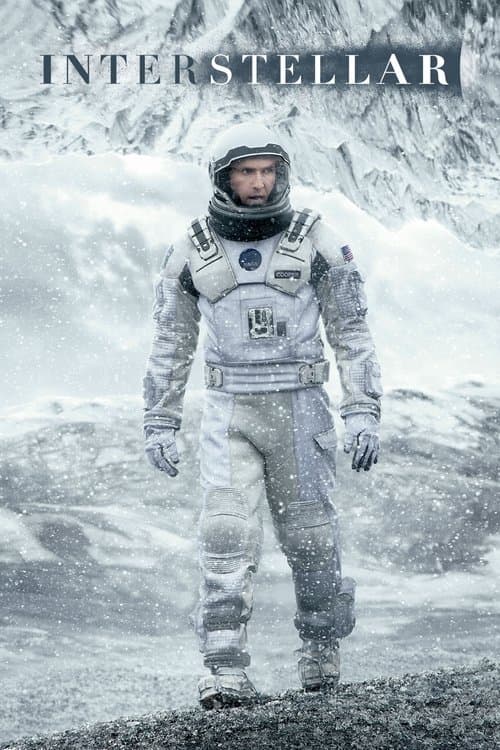
The journey proves perilous. On the first planet—an endless ocean plagued by towering waves due to the black hole Gargantua's gravity—Doyle dies, and time dilation costs the crew 23 Earth years. Back on a deteriorating Earth, an adult Murph joins NASA, grappling with her father's absence while working on Brand's quantum gravity equation to enable mass human exodus. The second planet, an icy wasteland, brings betrayal: lone survivor Dr. Mann falsifies data to summon rescuers, murders Romilly in a trap, and attempts to hijack the Endurance, killing himself in the process. With the ship damaged and spiraling toward Gargantua, Cooper and Amelia dock precariously, but fuel runs low. To give Amelia a chance at the third planet, Cooper detaches, plummeting into the black hole with TARS.
What Happens in the Ending
The film's climax unfolds in a cascade of high-stakes action and mind-bending revelation as Cooper and Amelia pursue the hijacked Endurance. After Mann's fatal docking failure, Cooper and Amelia, in a ranger craft, chase the spinning spacecraft toward Gargantua's maw. With CASE's piloting, they execute a desperate manual dock, but the ship's systems are failing, and they're inevitably pulled into the black hole's event horizon. As gravitational forces tear at the vessel, Cooper makes a selfless choice: overriding Amelia's pleas, he detaches the ranger carrying himself and TARS, slingshotting Amelia's lighter Lander toward the promising third planet while he falls deeper into the singularity.
Inside the black hole, Cooper doesn't perish but enters a surreal, four-dimensional tesseract—a constructed space where time becomes a tangible dimension, like rooms in a house. Guided by an unseen intelligence, he witnesses his past life unfolding: his farm, the dust storm, Murph's childhood bedroom. Realizing the anomaly that led him to NASA was his own future influence, Cooper manipulates books and dust in the past room to communicate Morse code warnings to his earlier self and, crucially, to young Murph—encoding quantum data from TARS about the black hole's interior. This data, transmitted through gravity across time, embeds itself in Murph's wristwatch, the one Cooper gave her before leaving.
The tesseract collapses, ejecting Cooper and TARS into normal space near Saturn in the year 2156. They're rescued by a thriving human society aboard a massive O'Neill cylinder space station named Cooper Station after Murph, who solved the gravity equation using the watch's data, enabling humanity's salvation and relocation to space habitats. Cooper reunites with his now-elderly daughter Murph, who, aged and wise, urges him not to linger by her bedside but to seek out Amelia on the third planet. Moved by her words, Cooper commandeers a spacecraft with TARS and departs for Edmunds' planet. Meanwhile, on that distant world, Amelia Brand, having landed alone, activates the colony equipment with robot assistance. In a moment of quiet triumph, she removes her helmet, inhaling the breathable air of humanity's new home.
The Meaning Behind the Ending
At its core, Interstellar's ending transcends mere survival to probe the profound interplay of time, love, and human ingenuity. The tesseract symbolizes the ultimate triumph of parental devotion over the inexorable flow of time—Cooper literally reaches back to "fix" his mistakes, underscoring how love, as the film posits, is a force that bends the universe's rules, much like gravity itself. This isn't just sci-fi spectacle; it's a meditation on regret and redemption, where Cooper's actions close the loop he unknowingly started, revealing humanity's future as the architect of its past salvation. The black hole, Gargantua, serves as a metaphor for the unknown voids in our lives—personal losses, existential threats—that we must confront to emerge transformed.
Thematically, the ending grapples with moral complexity in sacrifice: Cooper's detachment isn't heroic bravado but a painful acknowledgment of his earlier abandonment of Murph, now repaid through temporal intervention. It comments on societal fragility, showing how individual lies (like Brand's and Mann's deceptions) nearly doom the collective, yet truth and persistence—embodied in Murph's decoding—forge a path forward. The final images of Amelia breathing free air evoke hope's quiet persistence, a subtle rebuke to despair, reminding us that humanity's story is one of enduring, flawed striving against cosmic indifference.
Character Arcs and Resolution
Cooper's arc culminates in bittersweet fulfillment. From a reluctant farmer haunted by his piloting past and paternal failures, he evolves into a temporal guardian, his promise to Murph realized not through physical return but by empowering her across decades. His reunion with an aged Murph—where roles reverse, and she becomes the wise parent—highlights the psychological toll of time's asymmetry, resolving his guilt with a poignant handover of legacy. Yet, his departure to find Amelia suggests an open-ended quest for personal connection, underscoring his growth from self-doubt to selfless action.
Murph's journey from angry child to humanity's savior reflects resilience born of abandonment's pain. Her frustration with her father's "betrayal" fuels her determination, and decoding the watch's message transforms that wound into purpose, allowing her to save the world her father left behind. It's a arc of psychological maturity, where intellectual pursuit heals emotional scars. Amelia, the mission's emotional anchor, resolves her arc with solitary optimism—her love for Wolf Edmunds (implied in her persistence) and belief in human potential lead to the colony's founding, embodying hope amid isolation. Even secondary figures like TARS, with his dry wit, contribute to resolution, serving as Cooper's unflinching companion in the void.
Alternate Interpretations
While the film presents the tesseract as a deliberate construct by future humans to guide their ancestors—closing the bootstrap paradox of the mission's origins—some viewers might interpret it as a hallucinatory manifestation of Cooper's dying mind, a psychological cope for his sacrifices. This reading emphasizes the ending's ambiguity around the singularity's mysteries, questioning whether the quantum data is truly objective or a projection of familial love's "transcendence." However, the narrative's internal logic, with Murph's tangible success and humanity's evident progress, leans against pure hallucination, favoring a cyclical view of time where free will and determinism entwine. Another lens could see Cooper's ejection and rescue as ironic punishment—eternal wandering for the man who bent time—adding moral complexity to his heroism.
Themes and Symbolism
The ending reinforces Interstellar's central themes of time's tyranny and love's defiance, subverting traditional sci-fi tropes by making emotional bonds the engine of plot resolution rather than technology alone. Symbolically, the wristwatch ticks as a heartbeat of connection, its quantum Morse a metaphor for how personal artifacts carry generational weight. Gargantua symbolizes societal collapse's pull—ecocide's dust storms on Earth mirror the black hole's inescapable gravity—yet the wormhole and tesseract represent ingenuity's escape hatches, critiquing humanity's shortsightedness while affirming our capacity for long-view redemption.
Broader commentary emerges on parental psychology: Cooper and Murph's bond illustrates how absence forges unbreakable ties, a truth resonant in fractured modern families. The O'Neill cylinder, named for Murph, symbolizes collective renewal, subverting isolationist survivalism (as in Mann's betrayal) for communal aspiration. Ultimately, the ending probes moral ambiguity in ambition—Brand's lie sustains hope but erodes trust—inviting reflection on the ethical costs of our species' drive to endure.
Final Thoughts
Interstellar's ending works masterfully because it balances intellectual awe with raw emotional truth, delivering a payoff that feels earned through the film's patient build of sacrifice and wonder. By intertwining hard science with human frailty, it leaves audiences contemplative: Are we defined by the time we lose, or the love that outlasts it? Nolan's vision doesn't tie every thread neatly—Amelia's future remains a horizon—but this openness amplifies its resonance, making the film not just a space odyssey, but a mirror to our deepest yearnings for connection amid uncertainty. For a story born of extinction's shadow, it ends in breathable light, a testament to why we persist.