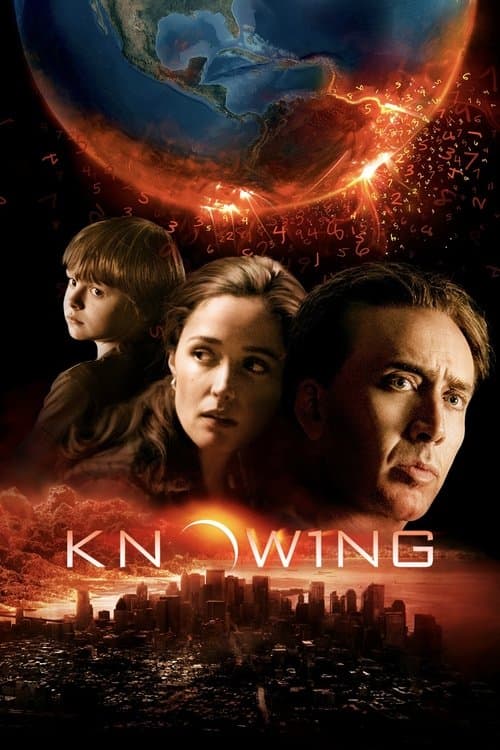
Knowing (2009): Ending Explained
"What happens when the numbers run out?"
A teacher opens a time capsule that has been dug up at his son's elementary school; in it are some chilling predictions -- some that have already occurred and others that are about to -- that lead him to believe his family plays a role in the events that are about to unfold.
9 min read
Release Year: 2009
Rating: 6.237/10
Runtime: 121 minutes
By Luna Sterling
Knowing (2009): Ending Explained
By Luna Sterling
The 2009 sci-fi thriller Knowing, directed by Alex Proyas, weaves a chilling tapestry of predestination, cosmic dread, and fragile human hope. Starring Nicolas Cage as the haunted MIT professor John Koestler, the film plunges viewers into a world where numbers etched in desperation foretell catastrophe. As whispers haunt the innocent and shadows of unseen watchers lurk, the story builds an unrelenting tension that questions whether fate can be outrun. For those searching for a Knowing ending explained, this article unpacks the film's haunting finale—revealing what literally unfolds, its deeper meanings, and the lingering ambiguities that make it so viscerally unforgettable.
Quick Recap
In 1959, at the newly opened William Dawes Elementary School in Lexington, Massachusetts, young Lucinda Embry participates in a time capsule project, drawing visions of the future. Guided by eerie whispering voices that seem to slither from the edges of her perception, she fills her paper with a cryptic sequence of numbers instead of artwork. Before she can complete it, her teacher intervenes, but Lucinda scratches the remaining digits into a closet door with her fingernails in a frenzy of urgency, her small hands raw and trembling. The capsule is buried, sealing her prophecy away for 50 years.
Fast-forward to 2009: The capsule is unearthed, and Lucinda's paper lands in the hands of nine-year-old Caleb Koestler, son of widowed astrophysicist John Koestler (Cage). John, still grappling with the loss of his wife in a hotel fire, deciphers the numbers as precise predictions of global disasters—dates, death tolls, and coordinates for events like the 9/11 attacks, Chernobyl, and Hurricane Katrina. Some have already scorched the earth; others loom. As John races to avert the future ones, including a devastating plane crash he witnesses in a haze of smoke and screams, Caleb begins hearing the same spectral whispers. Silent, stone-faced strangers appear, watching from the shadows, their presence a cold prickle on the skin. John tracks down Lucinda's daughter, Diana, and her granddaughter Abby, uncovering clues in Lucinda's abandoned mobile home: an engraving of Ezekiel's fiery chariot vision and the revelation that the final code—"EE"—stands for "Everyone Else," signaling total annihilation.
The plot hurtles toward apocalypse when John realizes the last date heralds a massive solar flare, a cataclysm no bunker can withstand. Diana, haunted by her mother's foretold death date, clings to denial as the group fractures. Whispers intensify, strangers intervene, and the air thickens with the metallic tang of impending doom, pulling John, Caleb, Diana, and Abby into a vortex of revelation and loss.
What Happens in the Ending
The film's climax erupts in a symphony of desperation and otherworldly intervention, leaving the screen pulsing with the heat of inevitable destruction. After John deciphers the engraved coordinates on the school closet door as a potential site of salvation—far from any cave refuge he initially proposes—Diana, gripped by hysteria and skepticism, bundles Caleb and Abby into her car and speeds away toward underground shelters. The night air hums with tension, headlights cutting through the darkness like desperate pleas.
At a desolate gas station, the whispering strangers—tall, silent figures with an ethereal, almost luminous pallor—materialize from the gloom. They hijack Diana's car, vanishing with the children inside. Diana, her face twisted in raw terror, steals an SUV and gives chase through rain-slicked roads, her breaths ragged and frantic. The pursuit ends in tragedy: her vehicle crashes, and she dies at precisely midnight on October 19, 2009, fulfilling Lucinda's childhood prophecy. John arrives moments later, cradling her lifeless hand, a smooth stone clutched in her palm—a final, tactile echo of the strangers' gifts.
The beings transport Caleb and Abby to Lucinda's mobile home, where John finds them amid the dim flicker of emergency broadcasts blaring warnings of the flare. Revealed as extraterrestrial "angels," these entities explain their mission: selecting "chosen" children to seed humanity's survival on interstellar arks. John, who never heard the whispers, is barred from joining; his role ends here. Heart-wrenching sobs fill the air as he urges a devastated Caleb to go with Abby, watching as the pair is gently led away, the rabbits from the ark symbolizing fragile new life.
The next morning, skies bruise orange under the flare's approach. John drives through Boston's chaos—honking horns, fleeing crowds, the acrid scent of panic—toward his estranged father's house. In a quiet, tear-streaked reconciliation, father and son embrace as the pastor whispers, "This isn't the end." John replies softly, "I know," his voice steady amid the gathering roar. The solar flare arrives as a gargantuan, fast-moving wall of fire, its blistering heat vaporizing Manhattan and sweeping across the Earth's surface in fiery volutes, erasing all adult life in a blinding, silent inferno.
Intercut with this annihilation, the ark deposits Caleb and Abby on a lush, alien world—an earthly paradise of verdant fields and whispering winds. They step out, wide-eyed, and run hand-in-hand toward a massive white tree, its branches arching like a beacon of rebirth, as other arks scatter across the horizon.
The Meaning Behind the Ending
At its core, the ending of Knowing is a visceral meditation on extinction and renewal, where humanity's end is not punishment but a cosmic reset. The solar flare symbolizes an uncontrollable force of nature—raw, indifferent, and biblical in scale—echoing the film's earlier disasters as harbingers of inevitable entropy. John's realization that caves offer no shelter underscores a profound helplessness, the heat of the flare licking at the edges of human denial like a fever dream. Yet, the strangers' intervention injects a thread of grace: they are stewards of survival, plucking innocence from the ashes to plant it elsewhere. The "Everyone Else" code crystallizes this—adults, burdened by loss and doubt, are left to the flames, while children embody unscarred potential.
Psychologically, the finale throbs with the tension of surrender. John's drive to his father's home, amid the orange-tinged apocalypse, feels like a ritual purging of isolation, the reconciliation a quiet exhale against the world's unraveling roar. The tree on the new planet, evoking the biblical Tree of Life, represents hope's stubborn root in desolation—a metaphor for humanity's legacy not in defiance, but in quiet endurance. It's an ending that lingers like the afterimage of fire: devastating, yet strangely cathartic, affirming that meaning emerges from the void.
Character Arcs and Resolution
John Koestler's arc, from a skeptical scientist mocking coincidence to a man embracing predestined loss, culminates in poignant acceptance. Haunted by his wife's death in a predicted fire—its embers still smoldering in his memory—he spends the film clawing at control, chasing numbers like lifelines. The ending resolves this through sacrifice: unable to save himself or Diana, he releases Caleb, his grief a heavy, tangible weight that propels him to reconcile with his pastor father. In their final embrace, as the flare's heat presses in, John finds peace—not in averting doom, but in familial bonds, whispering "I know" as a bridge between doubt and faith.
Caleb's journey from frightened boy hearing insidious whispers to chosen survivor mirrors a loss of innocence tempered by purpose. The voices, once a psychological torment prickling his ears, become a call to destiny, leading him to the ark with Abby. Diana's arc ends in tragic irony: her skepticism shatters too late, her death a visceral punctuation to Lucinda's prophecy, freeing her daughterly burden. Abby, the quiet observer, completes the cycle, her crayon-colored sun sparking John's revelation. Together, the children's escape resolves the film's paternal themes—John's letting go is his ultimate act of love, ensuring Caleb's future amid the psychological wreckage of goodbye.
Alternate Interpretations
Knowing's ending thrives on ambiguity, inviting viewers to parse its celestial saviors through multiple lenses. Are the strangers truly extraterrestrial angels, or divine messengers veiled in sci-fi garb? Their stone gifts and whispers evoke biblical visitations—echoing Ezekiel's chariot—suggesting a religious allegory where the flare is Judgment Day, and the children are the elect spared for a new Eden. The tree's white glow reinforces this, a subtle nod to paradise regained, subverting John's atheism with cosmic faith.
Alternatively, a secular reading frames them as advanced aliens enacting a pragmatic cull: humanity's flaws—wars, disasters—warrant intervention, with the arks as evolutionary arks preserving genetic potential. The "chosen" criterion (those who hear whispers) could imply innate sensitivity, a psychological selection rather than divine favor, adding unease to their ethereal poise. Is the new world truly paradise, or a controlled simulation? The film's refusal to clarify leaves a shadowy tension: salvation as benevolence, or cold eugenics? These layers ensure the ending's mood of hushed wonder persists, defying easy closure.
Themes and Symbolism
The finale amplifies Knowing's core themes of fate versus free will, where numbers bind the characters like invisible chains, their cold precision a counterpoint to human chaos. The whispers symbolize an inescapable call from the unknown, a psychological hum that erodes sanity, while the solar flare subverts disaster-movie heroism—no last-minute save, just the visceral burn of acceptance. Symbolically, fire recurs as purifier and destroyer: from Lucinda's frantic scratches to the plane's inferno and the final wall of flame, it scorches illusions of control.
Faith emerges as a quiet undercurrent, John's arc tracing from scientific rationalism to spiritual reconciliation, the pastor's words a balm against the apocalyptic roar. The arks and tree evoke Noah's flood and Eden, reinforcing themes of cyclical renewal—humanity's end as prologue to rebirth. Yet, the film's tension lies in subverted hope: survival for some means annihilation for most, a moody reminder that cosmic scales dwarf personal struggles, leaving an atmospheric residue of awe and isolation.
Final Thoughts
Knowing's ending works masterfully because it doesn't flinch from despair, instead alchemizing it into something transcendent. The literal blaze of destruction, intercut with the children's tentative steps into paradise, creates a rhythmic pulse of loss and possibility that resonates long after the credits. It's not a tidy resolution—ambiguities about the strangers and the new world add psychological depth, inviting rewatches to chase those whispers. For a film steeped in tension, this finale delivers catharsis without cheapening the dread, proving that in the face of the unknown, the most human response is to hold on, even as the fire rises. If you're piecing together the Knowing ending explained, it's a testament to Proyas's skill: unsettling, evocative, and profoundly moving.
Luna Sterling is a film critic specializing in genre thrillers and atmospheric narratives. Follow her for more deep dives into cinema's shadowy corners.