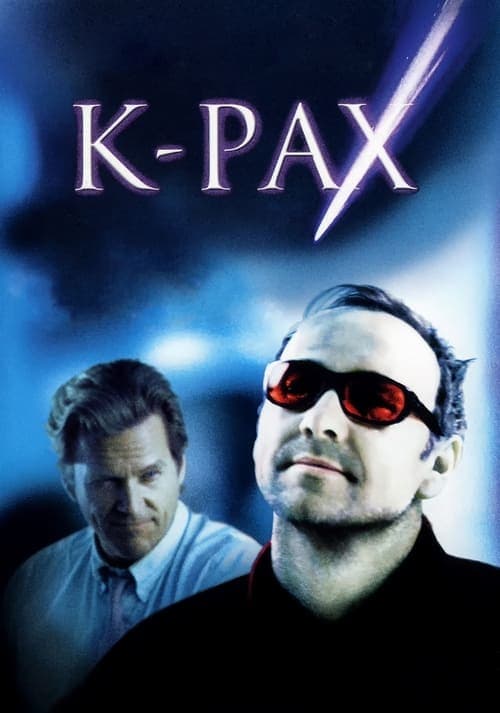
K-PAX (2001): Ending Explained
"Change the way you look at the world."
Prot is a patient at a mental hospital who claims to be from a far away planet. His psychiatrist tries to help him, only to begin to doubt his own explanations.
9 min read
Release Year: 2001
Rating: 7.213/10
Runtime: 120 minutes
By Luna Sterling
K-PAX (2001): Ending Explained
In the shadowy corridors of a Manhattan psychiatric institute, K-PAX (2001) weaves a haunting tapestry of doubt, delusion, and the fragile boundary between reality and the cosmos. Directed by Iain Softley, this psychological sci-fi drama stars Kevin Spacey as the enigmatic Prot—a patient who arrives claiming to hail from a distant planet—and Jeff Bridges as Dr. Mark Powell, the psychiatrist tasked with unraveling his story. As the film builds an atmosphere thick with unspoken tensions, the ending plunges viewers into a vortex of ambiguity, leaving hearts pounding with the chill of unanswered questions. If you've just watched K-PAX and are searching for a breakdown of its cryptic finale, this K-PAX ending explained dives deep into the literal events, symbolic layers, and lingering mysteries that make it one of cinema's most evocative conclusions.
Quick Recap
The film opens with a disheveled man, calling himself Prot, wandering into a subway station and claiming to be an extraterrestrial from K-PAX, a planet 1,000 light years away in the Lyra constellation. Committed to the Psychiatric Institute of Manhattan, Prot's serene demeanor and vivid descriptions of his homeworld immediately unsettle the staff. Dr. Mark Powell, a dedicated but skeptical psychiatrist, takes on his case, probing Prot's unwavering tales of faster-than-light travel and a utopian society free from Earth's cruelties. What begins as routine therapy spirals into obsession as Prot demonstrates uncanny abilities: he perceives ultraviolet light, resists powerful sedatives like Thorazine, and baffles astrophysicists with precise, unknown details about celestial mechanics.
As Powell digs deeper, Prot's influence ripples through the ward like a quiet storm. The other patients—haunted souls trapped in their own mental prisons—rally around him, hanging on his promises of escape. Prot reveals he can take one person back to K-PAX on July 27, igniting desperate pleas from the group. Powell, sensing a breakthrough, uses regression hypnosis to uncover buried trauma, piecing together that Prot might be the fractured persona of Robert Porter, a New Mexico man shattered by the brutal murder of his wife and child in 1996. Armed with a high school yearbook photo, Powell confronts Prot, who responds with cryptic amusement, urging him to care for "Robert" now that he's been found. The air grows heavier with anticipation as July 27 approaches, the date pulsing like a heartbeat in the film's tense undercurrent.
What Happens in the Ending
The finale unfolds on July 27 in a scene drenched in anticipatory dread, the hospital's sterile lights casting long, flickering shadows across the patients' expectant faces. As the clock ticks toward the predetermined hour, the staff monitors Prot closely, the room humming with the low buzz of surveillance equipment. Prot lies calmly on his bed, his eyes distant, evoking the vast emptiness of space. At the exact moment he predicted, the camera feed from his room erupts into blinding static—a visceral glitch that feels like the fabric of reality tearing, accompanied by an eerie silence that swallows the ward's murmurs.
When Dr. Powell rushes in, he finds not Prot, but Robert Porter curled on the floor in a catatonic stupor, his body limp and unresponsive, as if the life force within has been hollowed out. The transformation is stark: the vibrant, otherworldly Prot has vanished, leaving behind a shell of a man, his skin pale under the harsh fluorescents, breath shallow like the wind over barren plains. As orderlies wheel the mute Robert away, the patients react with a mix of grief and conviction—they don't recognize him as Prot and insist he's departed for K-PAX. Adding to the unease, Bess, a mute patient scarred by a house fire and one of those who begged to join Prot, is nowhere to be found. Her empty bed and the faint, lingering scent of her presence amplify the mystery; the group believes Prot has fulfilled his promise and taken her with him.
In the aftermath, Powell tends to the catatonic Robert with a quiet intensity, his voiceover narrating updates on the patients Prot inspired—many now stepping into normal lives, their therapies bearing unexpected fruit. Robert remains unresponsive, a living statue amid the institute's echoing halls. The film's voiceover shifts to Prot's ethereal tone, delivering a profound warning: the universe cycles eternally, repeating our mistakes in an endless loop, so this life is our singular shot to seize meaning. Moved by this, Powell mends his fractured relationship with his estranged son Michael, embracing a path of renewal. A post-credits sequence lingers on Powell gazing at the star-studded night sky, the cool breeze brushing his face, before he turns back to his everyday world—leaving viewers suspended in the night's infinite whisper.
The Meaning Behind the Ending
At its core, the ending of K-PAX symbolizes the collision of human fragility and cosmic possibility, a metaphor for how trauma can birth alternate realities as vivid as any star system. The static on the camera feed isn't just a technical flourish; it's a sensory rupture, evoking the disorienting hum of a mind fracturing under pressure, or perhaps the interference of an interstellar signal piercing our dimension. Prot's "departure" represents liberation—not just from Earth's gravity, but from the suffocating weight of grief. For Robert Porter, it's the shedding of a protective delusion, leaving him exposed and vulnerable, much like the raw nerve endings of a healed wound.
Thematically, the finale underscores redemption through empathy. Prot's voiceover about the universe's repetitive cycles serves as a haunting parable: our pains echo forever unless we choose differently, infusing the mundane with urgent, almost visceral purpose. Bess's disappearance amplifies this—her absence is a tangible void, a psychological scar that hints at the healing power of belief, even if it's illusory. The ending doesn't resolve the tension; it heightens it, mirroring the film's exploration of faith in the unseen, where the chill of doubt lingers like fog on a graveyard, inviting us to question whether salvation comes from within or from the stars.
Character Arcs and Resolution
Dr. Mark Powell's journey culminates in profound personal transformation, evolving from a rigid clinician bound by evidence to a man touched by the intangible. His confrontation with Prot shatters his certainty, and caring for the catatonic Robert becomes an act of quiet atonement—visceral in its intimacy, like tending a flame in the dark. By reconciling with his son, Powell embodies the film's message of breaking cycles, his arc resolving not in answers, but in renewed connection, the warmth of familial bonds cutting through the cold isolation of his profession.
Prot/Robert's dual arc fractures and reforms in the finale. As Prot, he's a beacon of otherworldly calm, drawing out the ward's buried hopes with a gravitational pull. But as Robert emerges, catatonic and stripped bare, it signifies the collapse of his coping mechanism—the alter ego born from unimaginable loss. His non-response to Powell's updates leaves his resolution open, a silent testament to enduring trauma, yet the patients' progress suggests Prot's influence endures, rippling outward like echoes in a vast chamber.
The patients, collectively, find cathartic release. Prot's inspiration unlocks their voices and futures, with Bess's vanishing as the ultimate, enigmatic payoff—her arc from mute survivor to presumed cosmic traveler a poignant closure, heavy with the scent of possibility amid loss.
Alternate Interpretations
K-PAX's ending thrives on ambiguity, offering dual lenses that keep the psychological tension alive. One interpretation sees Prot as a genuine alien entity, a symbiotic visitor inhabiting Robert's body. The static, Bess's disappearance, and Prot's prescient knowledge support this: his "return" to K-PAX is literal, a beam of light extracting him (and Bess) in a moment of transcendent hush, leaving Robert's shell behind. This view casts the film as a subtle invasion narrative, where extraterrestrial wisdom heals earthly wounds, the night sky in the post-credits a portal of lingering wonder.
Conversely, a psychological reading frames everything as Robert's elaborate delusion—a masterful defense against grief's abyss. The static? A metaphorical brain glitch during dissociation. Bess's absence could be a tragic escape, perhaps suicide enabled by Prot's empowering rhetoric, her body lost in the institute's shadows. Prot's voiceover becomes Robert's subconscious plea, urging Powell (and himself) to defy repetition. This lens emphasizes mental health's visceral toll, with the ending as a bittersweet recovery: Robert's catatonia a necessary limbo before potential rebirth, Powell's changes the true "alien" intervention of compassion.
Neither is definitive; the film's refusal to clarify heightens the unease, like a half-remembered dream fading into dawn.
Themes and Symbolism
The ending reinforces core themes of belief versus skepticism, using symbolism to subvert expectations. K-PAX itself symbolizes an unattainable utopia—a counterpoint to Earth's gritty underbelly, from the abattoir's blood-soaked floors where Robert once worked to the institute's confining walls. The date July 27 evokes predestination, a ticking clock that builds palpable tension, symbolizing how trauma's anniversaries can eclipse reality.
Repetition and cycles dominate, with Prot's warning subverting sci-fi tropes: instead of awe-inspiring infinity, it's a claustrophobic trap, the universe's loop mirroring personal ruts. Light—ultraviolet visions, the static's flash, the starry gaze—symbolizes enlightenment and escape, yet its elusiveness underscores isolation. The film subverts redemption arcs by leaving Robert catatonic, challenging tidy resolutions and emphasizing empathy's quiet, enduring power over cosmic spectacle.
Final Thoughts
K-PAX's ending is a masterstroke of restraint, its atmospheric ambiguity leaving a resonant chill that lingers long after the credits. By blending psychological depth with subtle sci-fi intrigue, it doesn't just explain Prot's enigma—it immerses us in the human psyche's vast, uncharted territories. Whether you lean toward the alien truth or the delusion's grip, the finale works because it mirrors life's own mysteries: no absolute answers, only the tense pull toward meaning. For fans dissecting K-PAX ending explained queries, it's a reminder to gaze upward, make this cycle count, and embrace the shadows where healing hides. A haunting gem that rewards rewatches, it proves cinema's power to unsettle and uplift in equal measure.