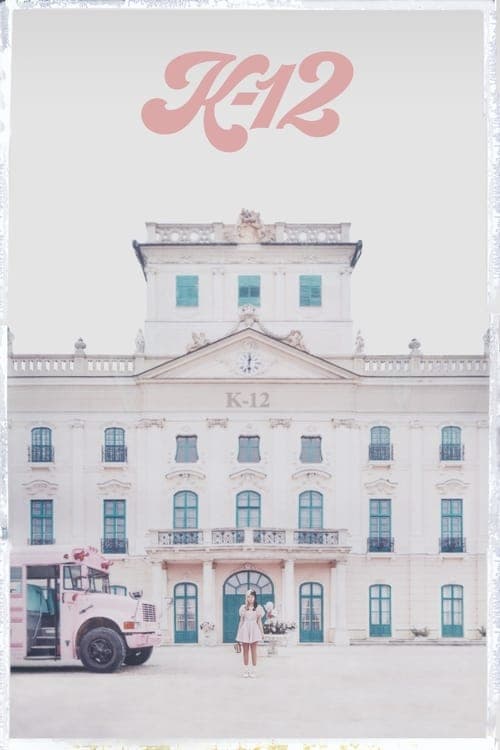
K-12 (2019): Ending Explained
"When the bell rings, you must be in your assigned seat…"
Cry Baby, a strong and sensitive girl, is sent off to a disturbing sleepaway school that’s hidden underneath a grandiose façade. Luckily, she has a sweet and unapologetic best friend who sticks up for her when she gets bullied by the other students whose brains are under control by the Principal and his wicked staff. With the help of the magical friends they meet along the way, as well as an Angelic Spirit Guide, they are able to gain the strength they need to fight off the school’s belligerent patriarchal conditioning.
7 min read
Release Year: 2019
Rating: 7.744/10
Runtime: 92 minutes
By Luna Sterling
K-12 (2019): Ending Explained
By Ellis Carver
In Melanie Martinez's surreal musical K-12 (2019), the boundaries between dream, nightmare, and allegory blur in a haunting critique of institutional control. As a film critic with a penchant for unpacking the psychological layers of indie visions, I've long admired how K-12 transforms a sleepaway school into a metaphor for societal oppression. This ending explained dives deep into the film's finale, exploring its literal events, symbolic weight, and the moral ambiguities it leaves us pondering. If you've just watched K-12 and are searching for clarity on Cry Baby's triumphant—or is it tentative?—escape, read on for a thoughtful breakdown that reveals the human truths beneath its fantastical surface.
Quick Recap
K-12 follows Cry Baby, a resilient yet vulnerable young girl, who is thrust into a nightmarish sleepaway school masquerading as an idyllic institution. Beneath its polished exterior lies a dystopian regime enforced by the tyrannical Principal and his complicit staff, who manipulate the students' minds to perpetuate a rigid, patriarchal order. Cry Baby, often targeted for her sensitivity and defiance, finds solace and strength in her loyal best friend—a bold, unyielding ally who refuses to let the bullying slide. Together, they navigate a world where conformity is weaponized, and individuality is punished.
As the story unfolds, Cry Baby and her friend encounter a cadre of magical allies, each embodying facets of rebellion and self-discovery. These encounters build toward a collective awakening, aided by an ethereal Angelic Spirit Guide who whispers truths about inner power. The film's tension escalates as the duo uncovers the school's insidious brainwashing, a system designed to suppress female autonomy and enforce subservience. Leading into the ending, Cry Baby's journey has evolved from isolated suffering to a budding revolution, setting the stage for a climactic confrontation with the forces of control.
What Happens in the Ending
The final scenes of K-12 unfold in a whirlwind of surreal confrontation and cathartic release, culminating in Cry Baby and her allies' direct assault on the school's oppressive core. As the Principal and his staff tighten their grip—manifesting through hallucinatory sequences of enforced obedience and psychological torment—Cry Baby, her best friend, and their magical companions rally under the guidance of the Angelic Spirit Guide. The Spirit Guide appears in a luminous vision, urging them to harness their collective strength, symbolizing a transcendence beyond the physical confines of the school.
Literally, the ending depicts a chaotic uprising in the school's hidden underbelly, where the brainwashed students begin to stir from their trance. Cry Baby leads a musical sequence of defiance, her voice rising in song as she confronts the Principal directly. The staff's attempts to reassert control—through spells of conformity and physical barriers—crumble as the magical friends unleash their powers: illusions that expose the Principal's facade, bursts of empathetic energy that free the students' minds, and a unifying chant that shatters the patriarchal illusions. In a pivotal moment, Cry Baby channels the Spirit Guide's wisdom to dismantle the Principal's throne-like command center, causing the school's grandiose structure to fracture and reveal its rotten foundation.
The sequence peaks with the Principal's defeat; he is not killed but rendered powerless, his authority dissolving into a pathetic echo as the students awaken en masse. Cry Baby and her best friend emerge from the rubble, hand in hand, stepping into an ambiguous dawn outside the school's collapsing walls. The final shot lingers on Cry Baby's face—tear-streaked yet resolute—as the group walks away, the Angelic Spirit Guide fading into the horizon like a benevolent specter.
The Meaning Behind the Ending
At its heart, the ending of K-12 represents a profound metaphor for breaking free from internalized oppression, particularly the subtle tyrannies of patriarchal conditioning that shape young minds. The school's collapse isn't just a literal demolition; it's a symbolic purging of societal facades that demand conformity at the expense of authenticity. Cry Baby's confrontation with the Principal embodies the psychological battle against authority figures who masquerade benevolence while enforcing control—think of it as a dreamlike allegory for how institutions like schools or families can brainwash vulnerability into submission.
The Angelic Spirit Guide serves as a beacon of inner wisdom, suggesting that true liberation comes from within, not external saviors. This ending underscores a moral complexity: victory feels earned but fragile, reminding us that patriarchal structures don't vanish with one rebellion; they linger in the psyche, requiring ongoing vigilance. It's a contemplative nod to the human truth that sensitivity, often weaponized against the marginalized, can become the sharpest tool for resistance. Societally, K-12 critiques how education systems perpetuate gender norms, with the ending's dawn symbolizing hope amid the ruins of outdated power dynamics.
Character Arcs and Resolution
Cry Baby's arc reaches a poignant resolution in the ending, transforming her from a isolated target of bullying—her sensitivity painted as weakness—into a catalyst for collective change. Her journey reflects the psychology of trauma recovery: initial withdrawal gives way to alliance-building, culminating in her leading the charge against the Principal. This isn't a tidy redemption; her tears in the final shot hint at the lingering scars of conditioning, emphasizing that personal growth is nonlinear and fraught with doubt.
Her best friend, the unapologetic defender, completes her arc as the embodiment of unwavering solidarity, her role evolving from protector to equal partner in the uprising. The magical friends and Spirit Guide, while more archetypal, resolve as extensions of Cry Baby's psyche—fragments of strength she integrates, suggesting a holistic self-acceptance. The Principal and staff, antagonists of systemic evil, don't arc toward redemption; their defeat resolves the plot's central conflict by exposing their hollowness, a commentary on how power corrupts without self-reflection. Overall, these resolutions affirm that character growth in K-12 is communal, rooted in the moral complexity of interdependence over isolation.
Alternate Interpretations
The ending of K-12 invites ambiguity, leaving room for multiple lenses. One interpretation views it as a literal triumph: the school's destruction signals an unequivocal escape from patriarchal hell, with Cry Baby's group stepping into a freer world. Yet, a more contemplative reading sees it as cyclical— the dawn outside could merely be another facade, implying that societal conditioning persists beyond institutional walls. Is the Angelic Spirit Guide a reliable ally, or a projection of Cry Baby's fragile hope, hinting at unresolved mental turmoil?
Psychologically, some might interpret the finale as Cry Baby's internal revolution: the "fight" as a metaphor for therapy or self-actualization, where the Principal represents internalized misogyny. This ambiguity subverts expectations of a clean win, forcing viewers to grapple with whether true freedom is achievable or forever elusive in a world rife with subtle oppressions. These layers add depth, rewarding rewatches with fresh insights into the film's dreamlike ambiguity.
Themes and Symbolism
The ending reinforces K-12's core themes of empowerment through vulnerability and the subversion of patriarchal control, while weaving in symbolism that elevates its societal commentary. The crumbling school symbolizes the fragility of imposed structures—grand on the surface, but built on coercive lies—mirroring how societies condition women to self-doubt. Magical elements, like the Spirit Guide's ethereal light, represent untapped feminine intuition, a counter to the Principal's brute authoritarianism, highlighting the theme that emotional intelligence trumps rigid dominance.
Broader motifs of bullying as systemic violence are subverted here: the students' awakening turns victimhood into agency, commenting on how collective resistance dismantles isolation. Morally complex, the ending questions redemption's limits— the staff's defeat feels just, yet it probes the human truth that oppressors are often products of their own conditioning. Symbolically, the hand-holding escape evokes sisterhood's enduring power, a subtle rebuke to individualism in favor of communal healing.
Final Thoughts
K-12's ending works masterfully because it balances catharsis with contemplation, delivering a visceral rebellion that lingers as a quiet interrogation of freedom's cost. In a film brimming with musical metaphors for inner conflict, this finale doesn't spoon-feed resolution; instead, it invites us to reflect on our own battles against societal cages. For Cry Baby, it's a hard-won step toward selfhood, but for audiences, it's a mirror to the patriarchal echoes in our lives. Flawed in its surreal excesses perhaps, but profoundly effective in its thematic punch—K-12 ends not with a bang, but with a dawn that dares us to believe in change. If you're unpacking themes of resilience and resistance, this conclusion cements the film's place as a modern fable worth revisiting.