Inside (2023): Ending Explained
"A solitary exhibition."
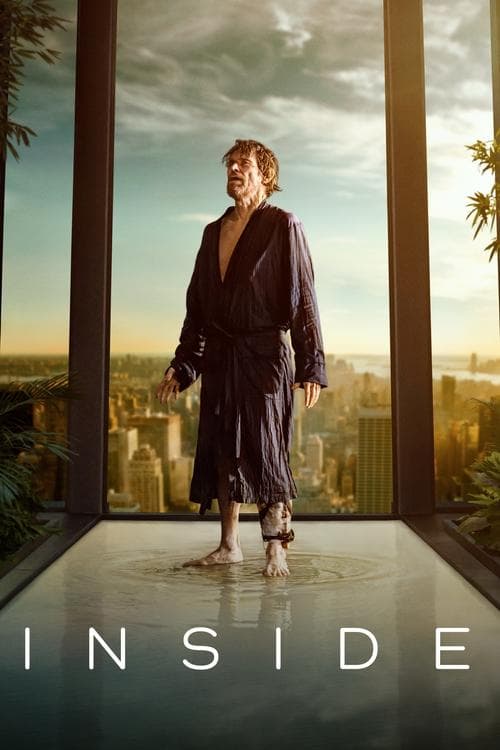
An art thief trapped in a New York penthouse after his heist doesn't go as planned. Locked inside with nothing but priceless works of art, he must use all his cunning and invention to survive.
7 min read
Release Year: 2023
Rating: 5.627/10
Runtime: 106 minutes
By Ellis Carver
Inside (2023): Ending Explained
As Ellis Carver, I've long been fascinated by films that trap their protagonists in confined spaces, forcing a confrontation with the self amid crumbling illusions. Charles Williams' Inside (2023), starring Willem Dafoe as the beleaguered art thief Nemo, is a masterclass in psychological descent, blending survival thriller with existential meditation. In this ending explained, we'll unpack the film's haunting conclusion, delving into its literal events, symbolic layers, and the moral ambiguities that linger long after the credits roll. If you're searching for clarity on Nemo's fate or the deeper truths Inside unearths about art, isolation, and human resilience, read on.
Quick Recap
Inside follows Nemo, a cunning art thief whose meticulously planned heist unravels in spectacular fashion. Disguised as a handyman, he infiltrates the opulent Manhattan penthouse of a reclusive art collector, aiming to steal three prized Egon Schiele works. But when he can't locate the elusive self-portrait, his exit triggers the building's high-tech security system, sealing him inside like a fly in amber. Abandoned by his criminal contacts, Nemo faces a gauntlet of environmental torments: a malfunctioning thermostat swings from sweltering heat to bone-chilling cold, while food and water dwindle to desperate scraps from an indoor garden's timed sprinklers, the collector's aquarium fish, and forgotten dog food.
Weeks blur into a nightmarish limbo as Nemo's escape attempts grow increasingly elaborate and futile. He watches helplessly as a pigeon, trapped by the same bird netting he exploited to enter, starves to death on the patio—a grim mirror to his own plight. Obsessed with the young housekeeper he dubs "Jasmine," glimpsed through security feeds, Nemo bangs futilely on the door during her visits, her earphones rendering her oblivious. His body and mind fray: tooth decay sets in, hallucinations flicker at the edges of vision, and a catastrophic fall from his makeshift scaffold shatters his leg. Yet amid the decay, Nemo discovers a hidden closet passage leading to the missing Schiele self-portrait and William Blake's The Marriage of Heaven and Hell, igniting a spark of creative fervor. He begins sketching on the walls, transforming the prison into a canvas, all while inching toward freedom via the skylight.
What Happens in the Ending
The film's climax unfolds in a quiet, almost serene devastation, contrasting the chaos that preceded it. As Nemo's health spirals—his splinted leg throbbing, sanity ebbing—he finally breaches the skylight's frame after weeks of laborious disassembly, using tools fashioned from splintered furniture. In a bold bid for rescue, he triggers the smoke alarm, flooding the penthouse in a deluge that soaks his makeshift art and the collector's treasures alike. But no sirens wail; no rescuers arrive. The outside world remains indifferent.
In this flooded ruin, Nemo pens a sprawling apology on the penthouse walls, etching his childhood anecdote into the narrative's core. Recalling his teacher's fire drill—where he chose to save his cat, an AC/DC record, and his sketchbook over his family—he reflects bitterly: the cat perished, the album was never returned, but the sketchbook endured. "Art is for keeps," he muses, extending this to his current ordeal. He apologizes for the intrusion and destruction but insists it was inevitable: "There is no creation without destruction." He claims to have "saved" three pieces of art, echoing his heist’s original intent but twisted into something profoundly personal.
The screen fades to a static tableau: the colossal scaffolding looms like a skeletal monument, reaching the now-open skylight. Sunlight filters through, illuminating the wreckage below. A faint shadow passes across the glass from above—subtle, fleeting—hinting at movement beyond the trap. The film cuts to black, leaving Nemo's ultimate fate unspoken.
The Meaning Behind the Ending
At its heart, the ending of Inside is a poignant elegy for the artist's soul, forged in isolation's crucible. The open skylight symbolizes not just physical escape but a rupture in Nemo's self-imposed cage—a breakthrough where survival gives way to transcendence. The shadow, that enigmatic silhouette, evokes hope's fragile dawn, suggesting Nemo's ingenuity has prevailed, perhaps crawling to freedom on his broken body. Yet it's laced with irony: the penthouse, once a sterile vault of commodified art, is now a submerged testament to Nemo's own creations, his wall drawings a defiant reclamation.
Thematically, the ending grapples with creation's violent underbelly. Nemo's note crystallizes this, drawing from Blake's The Marriage of Heaven and Hell—discovered in the hidden room—to argue that destruction is art's necessary shadow. By "saving" three pieces (implied as the Schiele works, now perhaps ruined or reimagined through his lens), Nemo subverts his thief's greed into a moral act, pondering whether true art endures beyond ownership. It's a contemplative nod to human truths: in extremity, we strip away facades, revealing our primal drive to create amid ruin. Societally, it critiques the elite's hoarding of beauty—Nemo's invasion exposes the penthouse as a gilded tomb, where art starves like the pigeon, until a thief breathes life into it.
Character Arcs and Resolution
Nemo's arc is a slow unraveling and rebirth, from opportunistic intruder to introspective survivor. Initially defined by cunning detachment—his childhood choice of objects over people hints at early emotional walls—trapped isolation forces a reckoning. His obsession with Jasmine underscores a yearning for connection, her earphone-clad indifference mirroring the world's apathy. Injuries and hallucinations peel back layers, exposing vulnerability: the broken leg grounds him literally and figuratively, while wall sketches mark his evolution from consumer of art to creator.
The resolution is bittersweet, unresolved in body but complete in spirit. Nemo doesn't merely escape; he redefines salvation. By leaving his apology, he achieves catharsis, forgiving himself through the lens of necessity. If the shadow signals escape, it's a pyrrhic victory—freedom bought with his humanity's fragments. His journey illuminates moral complexity: is he villain or visionary? A thief who destroys to preserve, embodying the thief's psychology as both predator and poet.
Alternate Interpretations
Inside's ending thrives on ambiguity, inviting multiple lenses. The shadow through the skylight could imply literal escape, Nemo hauling himself to safety after the flood, his "saved" art perhaps smuggled out in spirit if not substance. Optimists might see it as redemption's light, aligning with his note's defiant hope.
Yet darker readings abound. The shadow may belong to rescuers—Jasmine or authorities—finally alerted by the alarm, arriving too late to prevent Nemo's demise below. Or it's a hallucination, his mind conjuring liberation as delirium claims him; the open skylight then becomes a mocking portal to the unattainable, underscoring isolation's totality. Some interpret it as death's approach—a final, ethereal silhouette beckoning him upward, tying to the pigeon's fate and his decaying body. These possibilities reflect the film's moral grayness: escape as illusion, creation as futile against entropy.
Themes and Symbolism
The ending reinforces Inside's core themes of isolation's alchemical power and art's dual-edged sword. Symbolically, the scaffolding—cobbled from the penthouse's bourgeois excess—represents human ingenuity's triumph over oppression, a Babel tower piercing the elite's sky. The flood from the alarm evokes biblical deluge, washing away commodification to reveal raw truth, while the wall note subverts theft into manifesto, echoing Blake's heaven-hell union.
Broader societal commentary emerges in the penthouse as microcosm of inequality: Nemo, the outsider, disrupts the collector's sterile wealth, highlighting how art, meant to connect, isolates the powerful. Themes of moral complexity shine—Nemo's "no creation without destruction" probes whether violation can yield beauty, a human truth about progress's cost. The pigeon and aquarium fish symbolize collateral innocence, subverting survival-of-the-fittest tropes to question unchecked ambition.
Final Thoughts
Inside's ending is a triumph of restraint, its ambiguity a mirror for our own uncertainties, inviting viewers to ponder what we'd "save" in our personal fires. It works brilliantly because it trusts the audience, eschewing tidy closure for contemplative depth—Nemo's shadow lingers like an unfinished sketch, challenging us to fill in the voids. In a film year heavy on spectacle, this quiet devastation feels substantive, a reminder that true art, like Nemo's endurance, persists through the cracks. If it leaves you unsettled, that's the point: in the ruins, we find our most honest selves.