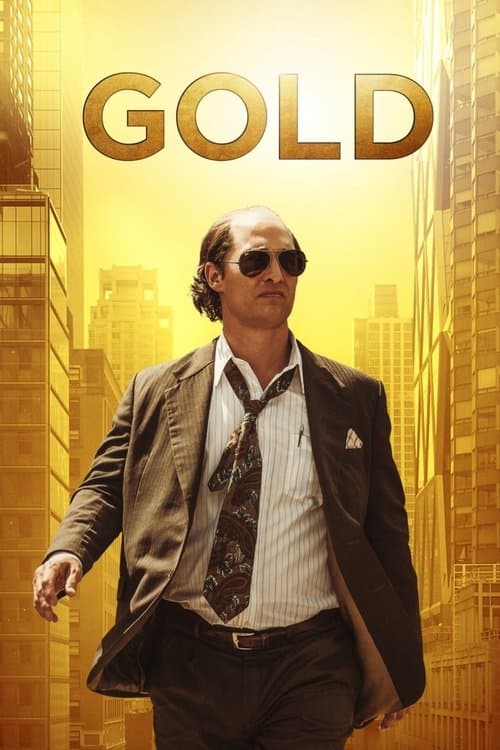
Gold (2016): Ending Explained
"Prove 'em all wrong"
Kenny Wells, a modern-day prospector, hustler, and dreamer, is desperate for a lucky break. Left with few options, Wells teams up with an equally luckless geologist to execute a grandiose, last-ditch effort: to find gold deep in the uncharted jungle of Indonesia.
9 min read
Release Year: 2016
Rating: 6.62/10
Runtime: 120 minutes
By Ellis Carver
Gold (2016): Ending Explained
In the gritty, ambition-fueled world of Gold (2016), director Stephen Gaghan crafts a tale of dreams, deception, and the intoxicating lure of fortune. Starring Matthew McConaughey as the tenacious prospector Kenny Wells, the film draws loose inspiration from real-life mining scandals, blending high-stakes adventure with a sharp critique of unchecked greed. As viewers search for a "Gold ending explained," this article delves into the film's climactic twists, unpacking the literal events, symbolic layers, and moral ambiguities that leave audiences pondering long after the credits roll. What does the final revelation say about success, betrayal, and the human cost of chasing gold?
Quick Recap
Gold opens in 1981 with a young Kenny Wells idolizing his father, a rugged prospector running the family business, Washoe Mining. Fast-forward seven years after his father's death, and Kenny (now played by McConaughey) is a shadow of that legacy—a washed-up hustler whose company is bankrupt, operating out of his girlfriend Kay's dive bar. Desperate for a breakthrough, Kenny is haunted by a dream that propels him to Indonesia, where he tracks down eccentric geologist Michael "Mike" Acosta (Édgar Ramírez). Despite their mutual financial woes, Kenny pawns everything to fund a wildcat expedition in the remote jungle, promising Mike a 50-50 partnership sealed on a napkin.
The venture starts disastrously: harsh conditions drive away the crew, and Kenny collapses from malaria, hallucinating in a feverish haze. Upon recovery, Mike delivers joyous news—a massive gold strike. Back in America, Kenny's fortune skyrockets. Washoe secures $20 million from a Wall Street bank after Mike dazzles investors with core samples from the site. The stock soars 70 points on debut day, turning Kenny into a celebrity schmoozer, partying endlessly while his relationship with Kay (Bryce Dallas Howard) frays amid his flirtations and her insecurities. Corporate intrigue escalates when mining mogul Mark Hancock offers $300 million to buy out Washoe, but Kenny refuses, clinging to his father's name. Triumph turns to turmoil as the Indonesian government, influenced by Hancock's connections (including a former U.S. president on the board), shuts down the mine.
Undeterred, Mike hatches a scheme to bribe their way back in, enlisting the son of President Suharto after Kenny boldly strokes a caged tiger to prove his mettle. The mine reopens, ballooning into a $30 billion enterprise with Washoe holding a 15% stake. Kenny's life peaks with a golden pickaxe award, but cracks appear: Mike abruptly leaves during Kenny's acceptance speech, and Kay has moved on. The next day, chaos erupts as Kenny fights through a mob outside his office, learning the devastating truth that sets up the film's explosive finale.
What Happens in the Ending
The ending of Gold unfolds in a rapid cascade of revelations and quiet reckonings, stripping away the illusions of wealth and partnership that defined Kenny's arc. As Kenny arrives at his gleaming office amid a frenzy of angry investors and reporters, the scandal breaks: the gold strike was a fraud. Mike, it turns out, orchestrated the deception through "salting"—planting fake gold samples in the drill cores. The gold used was ordinary "river gold" panned from local Indonesian streams, which Mike had shrewdly acquired by trading promises of freshwater to the villagers earlier in the expedition. This ties back to a subtle early scene where locals sift for gold in the river, foreshadowing the con's origins.
Word spreads like wildfire: Washoe's stock plummets, the mine is seized, and Mike has vanished with a fortune. Kenny, now persona non grata, is hauled in for FBI questioning in a dingy hotel room he can no longer afford—the same space where he once dreamed big. Retelling his story from a worn armchair, Kenny insists on his innocence, and the agents seem to buy it, painting Mike as the mastermind. They reveal chilling details: Mike was apprehended by Indonesian authorities while fleeing but "possibly forced" to jump from a helicopter 1,000 feet above the jungle. His body, when found, was mutilated beyond recognition—hands and face gnawed away by wild animals—leaving his death unconfirmed. Adding insult to injury, both Mike and a corrupt Indonesian minister dumped their shares before the crash, netting Mike $164 million in total.
Broken but resilient, Kenny returns to Kay's doorstep, offering a heartfelt apology. She takes him back, and in a moment of domestic normalcy, Kenny sifts through piled-up mail from their separation. Among the bills, he uncovers an unassuming envelope containing the original napkin contract scrawled with "50–50." Tucked beneath it is a bank deposit slip from the First Bank of Gibraltar (Queens Lane Branch, United Kingdom), showing $82 million credited to Kenny's name—precisely half of Mike's haul. The screen fades on Kenny's stunned expression, a mix of betrayal, vindication, and quiet triumph, as the implications sink in. No explicit resolution follows; the film ends on this ambiguous note, leaving viewers to grapple with the windfall's reality and Kenny's next move.
The Meaning Behind the Ending
At its core, the ending of Gold symbolizes the hollow core of the American Dream, where fortune is as much a mirage as the gold Kenny chased. The $82 million deposit slip isn't just a plot twist—it's a metaphor for tainted legacy, a half-measure of the partnership Kenny believed in. Mike's "gift" of the 50-50 split underscores the film's meditation on trust and exploitation: in a world of hustlers, even betrayal comes with a payout, but at what cost to the soul? The napkin, weathered and returned like a ghost from their jungle pact, represents the fragility of verbal bonds in cutthroat capitalism, contrasting the raw, unpolished optimism of their initial deal with the sanitized deceit of Wall Street.
Thematically, the finale critiques moral complexity in pursuit of wealth. Kenny's windfall arrives not through honest prospecting but via complicity in a scam he was blind to—mirroring how societal systems reward the naive enablers as much as the schemers. Mike's gruesome, unverified demise evokes the jungle's primal indifference, a nod to the savagery beneath civilized ambition. It's a contemplative reminder that gold, like success, corrupts absolutely, leaving survivors to weigh riches against the erosion of self.
Character Arcs and Resolution
Kenny Wells' journey culminates in a poignant, if bittersweet, resolution that humanizes his relentless dreamer persona. From a broke barfly idolizing his father's integrity to a fraudulent tycoon, Kenny's arc traces the psychology of delusion—his malaria-fueled optimism blinding him to red flags, much like his denial of personal failures with Kay. The ending resolves his arc not with redemption or ruin, but ambiguity: the $82 million offers financial salvation, allowing him to reclaim stability with Kay, yet it taints his prospector's pride. He's no longer the wide-eyed hustler, but a wiser man confronting the moral grayness of survival—apologizing to Kay signals growth, a return to grounded relationships over fleeting glamour.
Mike Acosta, the enigmatic geologist, resolves as the film's tragic antagonist, his arc a cautionary tale of unchecked cunning. Starting as Kenny's equal in desperation, Mike evolves into a calculating operator, using intellect to fabricate dreams. His flight and possible execution highlight the perils of overreaching; the 50-50 napkin suggests a flicker of loyalty or guilt, humanizing him beyond villainy. Kay's arc bookends the emotional stakes—her departure amid Kenny's excesses underscores themes of abandonment, but her acceptance at the end affirms resilience in love, positioning her as the moral anchor Kenny nearly loses.
Alternate Interpretations
The ending's ambiguity invites multiple lenses, particularly around the deposit slip's intent and Mike's fate. One reading sees it as Mike's final act of partnership—a genuine 50-50 split born from shared history, implying Kenny's innocence was rewarded in the con's spoils. This interprets the film as a twisted buddy story, where betrayal paradoxically affirms their bond, allowing Kenny a second chance at legitimacy (perhaps investing ethically this time).
Alternatively, the money could be a cruel taunt, Mike's way of ensnaring Kenny further in the scandal—$82 million might draw legal scrutiny, forcing Kenny to launder or forfeit it, perpetuating the cycle of moral compromise. Mike's unproven death adds another layer: Was the helicopter jump real, or a cover for his escape with the full $164 million? This conspiratorial view aligns with the film's nods to corporate-political intrigue, suggesting Mike lives on, pulling strings from the shadows. These interpretations hinge on the napkin’s symbolism—olive branch or noose?—reflecting Gold's refusal to moralize neatly, instead mirroring life's unresolved tensions.
Themes and Symbolism
The ending reinforces Gold's broader themes of illusion versus reality, subverting the classic rags-to-riches narrative by exposing it as a salted vein. Symbolically, the jungle represents untamed ambition's dangers—lush promise hiding fraud and fatality—while the golden pickaxe award mocks hollow accolades, a prospector's "holy grail" proven fool's gold. River gold, sourced from locals' humble panning, critiques colonialism and exploitation: Western dreamers strip indigenous resources to fake prosperity, echoing real-world mining ethics.
Morally complex, the finale subverts heroism; Kenny's "win" blurs victim and beneficiary, commenting on societal complicity in greed. Themes of legacy persist—Kenny honors his father's name by rejecting Hancock's buyout, only to inherit a corrupted version—while the tiger-stroking scene symbolizes risky bravado yielding temporary gains. Ultimately, Gold uses its ending to probe human truths: ambition's blindness, betrayal's intimacy, and fortune's double-edged allure.
Final Thoughts
Gold's ending works masterfully because it resists tidy closure, mirroring the messy psychology of its characters and the moral quagmires of real ambition. By landing on Kenny's quiet discovery amid domestic reconciliation, the film contemplates not just what we chase, but what we become in the pursuit—thoughtful, unflinching, and profoundly human. For audiences dissecting this "Gold 2016 ending explained," it's a reminder that true value lies beyond the glitter, in the enduring grit of self-reckoning. If the scam's exposure feels like a gut punch, the final twist delivers a lingering, contemplative exhale, inviting us to question our own golden illusions.