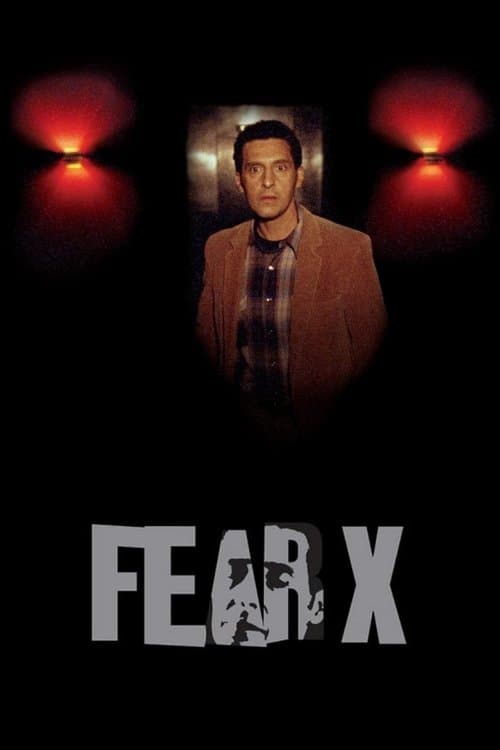
Fear X (2003): Ending Explained
"The Past Can Never Be Rewound."
When his wife is killed in a seemingly random incident, Harry, prompted by mysterious visions, journeys to discover the true circumstances surrounding her murder.
8 min read
Release Year: 2003
Rating: 5.797/10
Runtime: 91 minutes
By Luna Sterling
Fear X (2003): Ending Explained
Quick Recap
In Fear X, a gripping psychological thriller directed by Henrik Ruben Genz, the story centers on a group of friends seeking respite in a remote, historic hotel for a weekend getaway. Led by Rom, a charismatic bestselling author and motivational speaker, the group includes his fiancée Bianca, whose birthday they're celebrating, along with close friends Lou, Michael and his girlfriend Kim, Benny, Serena, and Meg. What begins as a lighthearted escape quickly unravels into a descent into terror. Rom, ever the guide, initiates a discussion on personal fears, positing that confronting them directly is the path to liberation. Each friend reluctantly shares their deepest anxieties, from Bianca's dread of drowning to Lou's skepticism toward the supernatural.
As night falls, the hotel's oppressive atmosphere thickens with an unnatural chill, shadows lengthening like grasping fingers across creaking wooden floors. Hallucinations and nightmarish manifestations tailored to their confessed fears begin to plague the group. Bianca glimpses swirling waters rising in the corners of rooms, their gurgling whispers echoing in her ears. Lou, the rationalist, faces spectral figures that blur the line between illusion and intrusion, their cold breaths fogging his vision. Michael and Kim are assailed by personalized horrors—twisted shapes that pulse with the rhythm of their racing hearts—while the others grapple with their own unraveling psyches. Paranoia seeps in like damp rot, fracturing alliances as accusations fly in the dim lamplight. The hotel, with its labyrinthine halls and musty scent of decay, reveals itself as more than a backdrop; it's a sentient predator, feeding on their vulnerabilities.
The tension builds to a fever pitch as the entity behind the torment reveals its insidious nature, turning the celebration into a crucible of dread. Rom's attempts to rally the group with his motivational rhetoric falter against the onslaught, his voice cracking like thunder in a storm of uncertainty.
What Happens in the Ending
The final act of Fear X plunges into visceral chaos, the air heavy with the metallic tang of fear-sweat and the distant, muffled screams that seem to emanate from the walls themselves. As the group's fractures deepen, the hallucinations escalate from disorienting visions to full-bodied assaults. Bianca, overwhelmed by her phobia, stumbles into a flooded corridor where illusory waters lap at her ankles, rising inexorably with a sloshing, suffocating pull that drags her under in a drowning gasp—her final, gurgling cry echoing through the vents.
Lou, clinging to logic until the end, confronts a shadowy entity in the hotel's grand lobby, its form shifting like smoke under flickering candlelight. It whispers doubts into his ear, cold and insistent, until he collapses, his skepticism shattered in a pool of his own unraveling mind. Michael and Kim, huddled in a barricaded room, face a joint torment: writhing tendrils of darkness that coil around them, amplifying their anxieties into a symphony of sobs and pleas, until silence claims them both. Benny, Serena, and Meg fare no better, each succumbing to personalized nightmares—flashes of fire, isolation, and loss—that leave their bodies limp amid the debris of overturned furniture and shattered glass.
Rom, the self-appointed leader, pieces together the horror's source in the hotel's attic, a claustrophobic space thick with dust motes dancing in weak moonlight. There, amid yellowed journals and flickering lantern light, he uncovers the truth: the hotel is a deliberate trap, orchestrated by an ancient, malevolent force that preys on fear like a parasite on flesh. This entity isn't supernatural in the traditional sense but a psychological construct amplified by the building's history of tragedy, designed to break spirits. In a twisted confrontation, Rom faces his own unconfessed terror—loss of control—manifesting as a mirror image of himself, mocking his every word with a hollow laugh that reverberates in his chest. He fights back with desperate fervor, but the entity overwhelms him, leaving him bloodied and broken on the splintered floorboards.
The screen fades to black on this bleak tableau: a single, surviving figure—perhaps Rom, perhaps not—staggers into the dawn light outside the hotel, the structure looming behind like a silent sentinel. No triumphant escape, no closure; just the lingering echo of labored breaths and the faint, receding howl of wind through cracked windows, implying that the fear has burrowed too deep to ever fully release its hold.
The Meaning Behind the Ending
At its core, the ending of Fear X symbolizes the inescapable grip of internalized fears, portraying them not as conquerable foes but as living entities that metastasize within the psyche. The hotel serves as a metaphor for the mind itself—a once-inviting refuge turned labyrinthine prison, its walls closing in with the weight of suppressed traumas. The orchestrated nature of the terror underscores a deeper commentary on vulnerability: by sharing their fears, the group unwittingly invites the entity to feast, much like verbalizing a wound invites infection. Sensory details amplify this—the relentless drip of water for Bianca evokes drowning not just physically but emotionally, a submersion in grief and helplessness.
Thematically, the finale reinforces the film's exploration of fear as a universal predator, one that thrives on isolation and doubt. Rom's discovery that the experience was "orchestrated to break them mentally and spiritually" points to a nihilistic truth: some horrors are self-perpetuating, designed by life's cruelties (or our own subconscious) to erode resilience. The bleak note leaves viewers with a visceral unease, the kind that lingers like a chill after a nightmare, questioning whether facing fears liberates or merely awakens them.
Character Arcs and Resolution
Rom's arc, from confident motivator to shattered idealist, culminates in profound irony. His belief in confronting fears head-on propels the group's doom, transforming him from guide to victim. In the ending, his confrontation with his doppelganger shatters his facade, resolving his journey in defeat— a man who preached control now embodies its illusion, staggering into uncertainty as a hollow shell.
Bianca's arc, tied to her birthday celebration, twists into tragic finality; her drowning vision resolves her fear by consuming her, symbolizing how unaddressed phobias can eclipse joy. Lou's skepticism crumbles, his resolution a forced acceptance of the unknown, paid with his sanity. The others—Michael, Kim, Benny, Serena, and Meg—arc toward collective dissolution, their bonds fraying into accusations and abandonment, highlighting how fear erodes relationships. No true resolution awaits; survivors, if any, carry scarred psyches, their arcs looping back to the film's thesis: fear's victory is perpetual.
Alternate Interpretations
The ending's ambiguity invites multiple lenses. One reading posits the entity as purely psychological—a mass hysteria triggered by the hotel's isolating atmosphere and Rom's fear exercise, with no supernatural element. The "orchestrated" trap could be metaphorical, the friends' own projections manifesting as shared delusions, ending in real deaths from panic-induced accidents rather than otherworldly force. This interprets the dawn staggerer as Rom emerging from a breakdown, the hotel's "history" merely suggestive lore amplifying suggestibility.
Alternatively, a more literal supernatural take sees the entity as an ancient curse, the orchestration a deliberate lure by unseen malevolents (perhaps the hotel's previous owners). Here, the few survivors—if Rom is among them—escape physically but remain spiritually ensnared, dooming future victims. A third, psychological thriller angle suggests Rom himself as the architect, his motivational shtick a cover for sadistic experimentation, with the ending revealing his unhinged mind as the true horror. These layers keep the tension alive, mirroring the film's elusive dread.
Themes and Symbolism
The ending amplifies Fear X's core themes of vulnerability and the illusion of control, subverting the self-help trope Rom embodies. Fear isn't a dragon to slay but a shadow that grows in the light of exposure, symbolized by the hotel's encroaching darkness—literal in its dim corridors, metaphorical in the characters' blinding panic. Water, fire, and isolation recur as symbols of elemental, primal terrors, their sensory assault (choking splashes, searing heat, echoing voids) underscoring psychological fragmentation.
Broader, the film critiques modern escapism: the getaway as trap reinforces how external retreats can't outrun internal demons. It subverts horror expectations by making fear interpersonal, turning friends into foes, and ends by affirming dread's inescapability— a subversive twist on empowerment narratives, leaving audiences to confront their own lurking anxieties.
Final Thoughts
Fear X's ending masterfully distills its atmospheric dread into a haunting meditation on fear's dominion, working brilliantly through its refusal of catharsis. The visceral immersion— from the clammy grip of illusions to the acrid sting of betrayal—leaves a psychological residue that's as unsettling as it is thought-provoking. While some may find its bleakness frustrating, this ambiguity elevates the film, inviting rewatches to peel back its layers. In a genre often reliant on jump scares, Fear X lingers like a half-remembered nightmare, proving that true horror resides in the mind's unquiet corners. If you're drawn to introspective chills over gore, this finale cements its status as a subtle, enduring gem.