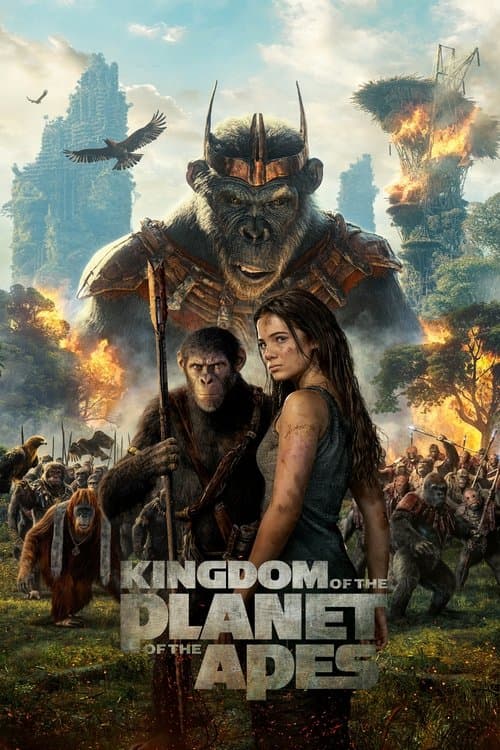
Kingdom of the Planet of the Apes (2024): Ending Explained
"No one can stop the reign."
Several generations following Caesar's reign, apes – now the dominant species – live harmoniously while humans have been reduced to living in the shadows. As a new tyrannical ape leader builds his empire, one young ape undertakes a harrowing journey that will cause him to question all he's known about the past and to make choices that will define a future for apes and humans alike.
8 min read
Release Year: 2024
Rating: 7.058/10
Runtime: 145 minutes
By Luna Sterling
Kingdom of the Planet of the Apes (2024): Ending Explained
As Luna Sterling, I've dissected countless cinematic climaxes, but the finale of Kingdom of the Planet of the Apes lingers like a fog-shrouded dawn—tense, transformative, and thick with the weight of unspoken histories. Directed by Wes Ball, this 2024 installment in the rebooted franchise pulses with a primal rhythm, where the rustle of wind through ancient ruins and the distant cries of eagles underscore a world teetering on the brink of rebirth or ruin. If you're searching for a thorough Kingdom of the Planet of the Apes ending explained, this breakdown dives into the visceral chaos of the final act, unpacking its literal events, symbolic depths, and the psychological ripples that echo Caesar's fractured legacy. Spoilers ahead—proceed with the caution of a scavenger in shadowed canyons.
Quick Recap
Generations after Caesar's era, the apes have splintered into clans, thriving in a wild, overgrown world where humans skulk like ghosts in the underbrush. Our story centers on Noa, a young chimpanzee from a peaceful eagle-riding clan, whose idyllic coming-of-age ritual shatters when the tyrannical Proximus Caesar— a self-proclaimed heir twisting Caesar's teachings into a doctrine of conquest—raids his village. Flames lick the night sky as Noa's father, Koro, falls to Proximus's forces, leaving the clan captured and Noa adrift in a haze of grief and fury. Driven by a raw need for vengeance and reunion, Noa sets out, his path shadowed by loss and the metallic tang of scorched earth.
Along the way, Noa crosses paths with Raka, a wise orangutan sage who breathes life into the true essence of Caesar's philosophy: kindness, not domination. They encounter Mae, a mute human scavenger whose silence hides sharp intellect and a hidden agenda. Together, they navigate treacherous ruins—crumbling airports choked with vines and rivers that swallow the unwary—uncovering Proximus's lair in an abandoned human bunker. Betrayals simmer like underground currents: Raka's sacrifice in a brutal bridge ambush leaves Noa and Mae captured, forcing uneasy alliances amid Proximus's opulent yet oppressive camp. As Noa grapples with the distortions of history, Mae reveals her quest for a "book" to restore human voices, setting the stage for a powder-keg confrontation that could drown empires in floodwaters.
What Happens in the Ending
The finale erupts in a symphony of desperation and defiance, the air heavy with the acrid bite of gunpowder and the roar of rushing water. Noa, Mae, Soona, and Anaya—his loyal clanmates—rig the bunker's dam with explosives, their movements hushed and frantic under the dim flicker of torchlight. Tension coils like a predator in the undergrowth as Trevathan, the scheming human collaborator, stumbles upon them; Mae's swift blade silences him forever, blood pooling dark on the concrete floor. Slipping into a concealed entrance, the group delves into the bunker's bowels, where shadows cling to rusted walls and the echo of dripping water amplifies every heartbeat.
Mae unearths a cache of human weapons, her fingers trembling as she claims the "book"—not a tome of stories, but a deciphering key etched with cold precision. Meanwhile, the apes stumble upon faded picture books in the depths, their pages whispering of a bygone human supremacy, the illustrations stark against the musty gloom. The fragile peace shatters when Proximus confronts them, his hulking form blocking the exit like a living eclipse, a blade pressed to Soona's throat. Mae's gunshot cracks the silence, felling the ape guard in a spray of misted blood, but Proximus bargains ruthlessly: reveal the weapons' location, or watch Noa's kin die. Mae refuses, her eyes steely in the half-light, and detonates the charges. Chaos unleashes—a torrent of icy floodwaters surges through the corridors, the ground shuddering as if the earth itself recoils.
In the deluge's grip, Noa faces Sylva in a claustrophobic chase through twisting pipes, the water's chill seeping into bones as screams mingle with the gurgle of rising tides. Noa squeezes through a narrow gap, his breaths ragged, condemning Sylva to a drowning doom behind rusted bars. Emerging into the storm-lashed open air, Noa clashes with Proximus atop precarious heights, the wind whipping fur and fabric like vengeful spirits. Proximus demands submission, his voice a thunderous growl, but Noa channels his father's ancient songs—melodies that vibrate through the soul, summoning a flock of eagles whose talons tear through the tyrant's defenses. Proximus plummets into the abyss below, his final roar swallowed by the canyon's maw.
As the waters recede, leaving a sodden wasteland of splintered wood and sodden earth, Noa's clan emerges, battered but unbroken. They trek homeward through mist-veiled forests, rebuilding their village amid the scent of fresh rain and smoldering embers. Mae bids Noa farewell at the threshold of dawn, her words hanging heavy: humans merit their resurgence as the planet's original rulers. Noa, his gaze shadowed by doubt, probes the cost to ape freedom. Mae vanishes into the wilds, arriving at a hidden human enclave near a satellite array. There, she hands over the key, igniting a spark of connection—satellites hum to life, their signals piercing the ether to link scattered human survivors across the globe.
The Meaning Behind the Ending
This ending throbs with the psychological undercurrents of cycles unbroken, where victory tastes bittersweet amid the damp chill of uncertainty. The flooding bunker symbolizes a literal and metaphorical purge: Proximus's empire drowns not just in water, but in the toxic perversion of Caesar's ideals, washing away the illusions of unchallenged ape dominance. Noa's mastery of his father's songs—evoking a spiritual communion with nature's fury—represents a reclamation of authentic legacy, the eagles as extensions of his inner resolve, tearing down the false idol. Mae's delivery of the key, meanwhile, ignites a fragile human renaissance, the satellites' activation a beacon in the narrative fog, hinting at communication's power to rebuild what silence has eroded.
At its core, the finale probes the tension between coexistence and conquest, the air thick with the unspoken dread of repeating history's cruelties. Noa's questioning of human resurgence underscores a deeper anxiety: freedom for one species might chain another, the psychological scar of loss etching doubt into triumph. It's a visceral reminder that power's throne is built on precarious ledges, where one fall can echo through generations.
Character Arcs and Resolution
Noa's journey crescendos from naive youth to reluctant sage, his arc steeped in the raw ache of bereavement. The village raid strips him bare, but the ending forges him anew—defeating Proximus not through brute force alone, but by weaving personal grief into communal strength, his songs a psychological bridge to his father's wisdom. He emerges as a guardian of balance, rebuilding his clan with a quiet resolve that tempers vengeance with empathy, though Mae's departure leaves him haunted by the fragility of their alliance.
Mae evolves from spectral outsider to catalyst of hope, her silence a mask for calculated resolve. Retrieving the key fulfills her quest to revive human agency, but her farewell to Noa reveals a matured vulnerability—the cost of her people's rise weighs on her, a subtle tension in her posture as she steps into the unknown. Soona and Anaya, symbols of unbroken bonds, find resolution in survival, their loyalty anchoring Noa's transformation. Proximus's demise, a visceral plummet, resolves his arc as cautionary hubris, his twisted faith in Caesar crumbling like wet stone.
Alternate Interpretations
The ending's ambiguities swirl like river mist, inviting multiple lenses. One view casts it as optimistic equilibrium: Noa's eagles and Mae's signal suggest a symbiotic future, where apes and humans might navigate shared skies without domination, the flood a cleansing reset. Yet, a darker read lingers in Noa's probing question—human revival could eclipse ape society, foreshadowing conflict and subverting the franchise's harmony. Is Mae's act selfless restoration or subtle conquest? The satellites' global reach might unite humans against apes, turning the key into a double-edged blade. These threads leave a psychological unease, the horizon veiled, challenging viewers to ponder if dawn brings alliance or war.
Themes and Symbolism
The finale reinforces the franchise's meditation on legacy's double helix—Caesar's teachings, once pure, mutate into Proximus's iron grip, only to be purified through Noa's visceral reckoning. Symbolism abounds: the eagles embody untamed freedom, their dives a metaphor for instinct over ideology, while the bunker's deluge evokes biblical floods, subverting ape supremacy with humanity's submerged past resurfacing. Broader themes of environmental reckoning pulse through the overgrown ruins, the planet's wild reclaiming whispering of hubris's cost. Psychologically, it explores identity's fragility—picture books shatter myths, forcing characters to confront the shadows of their origins amid the tension of evolving societies.
Final Thoughts
Kingdom of the Planet of the Apes caps its saga with an ending that grips like a talon in the storm—immersive, unflinching, and laced with the moody dread of what's to come. It works masterfully by blending explosive action with introspective pauses, the sensory onslaught of water and wind amplifying emotional stakes without overwhelming the narrative's heart. Yet, its open-ended pulse might frustrate those craving closure, leaving a lingering chill of ambiguity that mirrors real-world divides. Ultimately, this finale doesn't just explain the end; it ignites questions about our own world's fragile thrones, making it a haunting evolution in the Planet of the Apes legacy. If you're reeling from those final frames, revisit the film—the echoes grow deeper with each watch.