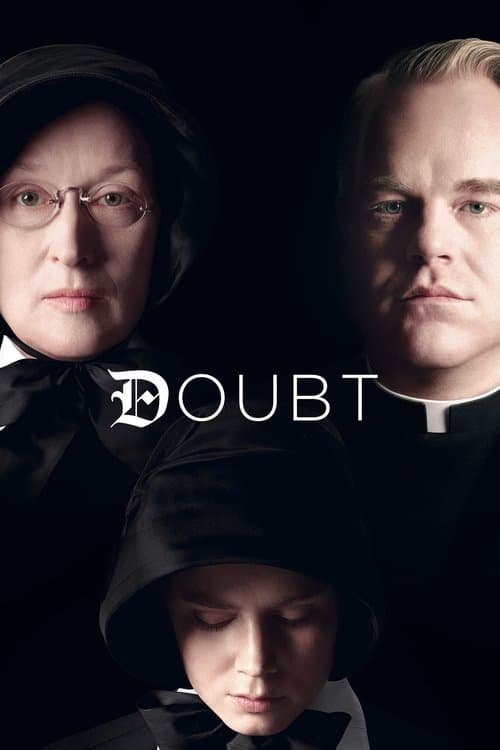
Doubt (2008): Ending Explained
"There are no simple truths."
In 1964 Bronx, two Catholic school nuns question the new priest's ambiguous relationship with a troubled African-American student.
8 min read
Release Year: 2008
Rating: 7.2/10
Runtime: 104 minutes
By Ellis Carver
Doubt (2008): Ending Explained
In the 2008 film Doubt, directed by John Patrick Shanley, the line between suspicion and truth blurs in a tense exploration of faith, authority, and unspoken fears. Set against the backdrop of a 1964 Bronx Catholic school, the story centers on Sister Aloysius Beauvier, a rigid principal played by Meryl Streep, who becomes convinced that the charismatic new priest, Father Brendan Flynn (Philip Seymour Hoffman), is abusing Donald Miller, the school's only Black student and an altar boy. Her suspicions ignite a moral battle that pits certainty against ambiguity, tradition against change, and individual conscience against institutional loyalty. As the narrative unfolds, these tensions reveal the fragile foundations of belief in a changing world, where doubt isn't just a personal failing but a communal force.
The film's power lies in its refusal to resolve the central question: Is Father Flynn guilty? Instead, it builds through layered confrontations that expose the characters' deepest vulnerabilities. Sister James (Amy Adams), the idealistic young teacher, grapples with her faith as she's drawn into Aloysius's crusade. Revelations about Donald's home life and Flynn's protective intentions complicate the accusations, forcing everyone to confront uncomfortable truths about race, sexuality, and power in a conservative Catholic environment. Leading into the ending, Aloysius has escalated her efforts by fabricating evidence of Flynn's past misconduct, pressuring him to request a transfer. Flynn departs after a final homily, leaving the school in a state of uneasy quiet—but the real climax emerges in the quiet aftermath, where the weight of unspoken doubts finally breaks through.
What Happens in the Ending
The film's final scenes unfold in a subdued, intimate manner, shifting from the confrontational energy of earlier acts to a moment of raw emotional reckoning. After Father Flynn's departure, Sister Aloysius meets with Sister James in her office, the stark, wintry light filtering through the windows underscoring the chill of unresolved tension. Aloysius reveals that Flynn has not been sidelined but promoted to a more prestigious position at a larger church. This news lands like a quiet bombshell, suggesting that her efforts to expose him have backfired spectacularly.
In a pivotal confession, Aloysius admits to James that she lied about contacting a nun from Flynn's previous parish to uncover his "history of infringements." She had no concrete proof—only her unshakeable certainty of his guilt. Yet, she rationalizes the deception: "If it were false, the ruse would not have worked." To Aloysius, Flynn's decision to resign and transfer is irrefutable evidence of his wrongdoing; why else would an innocent man yield? James, who has clung to her belief in Flynn's innocence throughout, is stunned by this revelation of manipulation, her wide-eyed faith shattered further.
The scene culminates in Aloysius's unexpected breakdown. As she reiterates her mantra—"In the pursuit of wrongdoing, one steps away from God"—her voice cracks. She adds that such steps come at a profound cost, then dissolves into tears, exclaiming, "I have doubts... I have such doubts!" The camera lingers on her face, capturing the erosion of her ironclad resolve. The film fades out on this vulnerable admission, leaving the audience with no tidy closure, only the echo of her words against the school's austere walls.
The Meaning Behind the Ending
At its core, the ending of Doubt represents the shattering of absolute certainty, transforming what began as a sermon on doubt's unifying power into a personal unraveling. Father Flynn's opening homily posits doubt as a "bonding" force in relationships and faith, much like the invisible "air" that unites us. By the film's close, this metaphor literalizes in Aloysius's confession: her pursuit of truth, driven by protective zeal, has isolated her, binding her instead to the very doubt she sought to eradicate. The promotion of Flynn symbolizes the triumph of institutional ambiguity over individual conviction— the Church's machinery absorbs scandal without admitting fault, leaving the accuser to bear the emotional toll.
This resolution underscores the film's meditation on moral complexity: in a world of hidden sins and societal blind spots, certainty can become its own form of tyranny. Aloysius's tears humanize her, revealing that her rigidity stems not just from piety but from a deep-seated fear of vulnerability. The ending critiques how doubt, when weaponized, erodes the soul, echoing broader human truths about the cost of vigilance in protecting the vulnerable. It's a poignant commentary on 1960s Catholic America, where racial integration, shifting gender roles, and whispers of sexual repression simmer beneath a facade of moral clarity.
Character Arcs and Resolution
Sister Aloysius's arc traces a descent from unyielding authority to fragile self-doubt, marking the film's most profound evolution. Initially a bulwark of tradition, she weaponizes her position to safeguard Donald, viewing Flynn as a predator preying on the school's fragile progress amid racial tensions. Her fabricated evidence and triumphant rationale initially affirm her role as a moral sentinel. Yet, the ending exposes the hollowness of this victory: Flynn's elevation leaves her isolated, her "certainty" revealed as a shield against her own uncertainties. Her breakdown signifies a reluctant embrace of humility, stepping "away from God" not in sin, but in the painful honesty of questioning her judgments—a resolution that feels more like an open wound than closure.
Sister James, the naive observer, completes her journey from wide-eyed innocence to weary disillusionment. Drawn into Aloysius's orbit, she loses her romanticized view of the Church's harmony, confronting the ugliness of gossip and power plays. Her shock at Aloysius's lie cements her growth, pushing her toward a more nuanced faith that tolerates ambiguity. Father Flynn's arc, though less resolved, shifts from defensive protector to elusive figure; his transfer preserves his status but at the cost of his rectory role, hinting at a life forever shadowed by suspicion. Donald Miller remains off-screen in the end, his arc a silent testament to the collateral damage of adult conflicts—protected, perhaps, but forever marked by the school's undercurrents of prejudice and fear.
Alternate Interpretations
The ending's ambiguity invites multiple lenses, refusing to confirm Flynn's guilt and thus fueling endless debate. One interpretation sees Aloysius's doubts as validation of her instincts: Flynn's quick exit, despite no proof, implies a hidden truth, with her breakdown reflecting the exhaustion of a righteous warrior in a complicit system. Here, the promotion becomes ironic commentary on the Church's protection of its own, reinforcing themes of institutional cover-ups.
Conversely, viewers might read Flynn's innocence as intact, his departure a pragmatic retreat from Aloysius's witch hunt. Her lie then becomes the true sin, her doubts a moral reckoning for slandering a man who offered Donald rare kindness amid familial abuse and racial isolation. This view casts the ending as a cautionary tale against unchecked zealotry, where doubt humbles the accuser rather than vindicating her. A third, more layered take posits mutual fallibility: both characters embody good intentions warped by circumstance, with the ending blurring guilt and innocence to mirror real-life scandals where truth eludes grasp. These interpretations hinge on the film's title—doubt isn't resolved; it's the enduring reality.
Themes and Symbolism
The ending reinforces Doubt's central themes of faith versus skepticism, the perils of gossip, and the intersection of personal morality with societal pressures. Doubt emerges not as weakness but as an essential, if uncomfortable, companion to belief—Flynn's initial sermon on its "unifying" nature finds tragic fulfillment in Aloysius's isolation, symbolizing how suppressing ambiguity fractures communities. The windstorm early in the film, which topples the old tree, symbolizes the disruptive force of change: Flynn represents progressive winds challenging Aloysius's rooted traditions, while the ending's quiet snow suggests a frozen stasis, where truths remain buried.
Symbolism abounds in subtler ways—the altar wine, initially a sign of transgression, becomes a metaphor for hidden indulgences in a repressive faith; Donald's undershirt in his locker evokes innocence tainted by adult suspicions. Broader commentary touches on 1960s racial dynamics: Mrs. Miller's plea highlights how Black families navigated white institutions for survival, subverting the narrative of abuse to reveal layered oppressions like homophobia and domestic violence. The ending subverts expectations of heroic justice, instead illuminating how moral complexity—doubt's true domain—defies easy binaries, urging viewers to confront their own certainties.
Final Thoughts
Doubt's ending is a masterstroke of restraint, trading explosive revelations for introspective ambiguity that lingers long after the credits. By centering Aloysius's tearful admission, it humanizes her crusade, transforming a story of accusation into a meditation on the soul's quiet fractures. This works brilliantly because it mirrors life's messiness: in matters of faith, abuse, and prejudice, certainty is often the illusion, and doubt the wiser path. For audiences grappling with the film's themes today, it remains a timeless reminder of empathy's necessity amid suspicion—profound, unsettling, and ultimately redemptive in its honesty. If Doubt teaches anything, it's that true conviction demands space for the shadows we can't quite illuminate.