Trick 'r Treat (2007): Ending Explained
"Poison, drowning, claw, or knife. So many ways to take a life."
Four interwoven stories that occur on Halloween: an everyday high school principal has a secret life as a serial killer; a college virgin might have just met the one guy for her; a group of teenagers pull a mean prank, and a bitter old recluse receives an uninvited guest.
8 min read
Release Year: 2007
Rating: 6.992/10
Runtime: 82 minutes
By Luna Sterling
Trick 'r Treat (2007): Ending Explained
By Luna Sterling
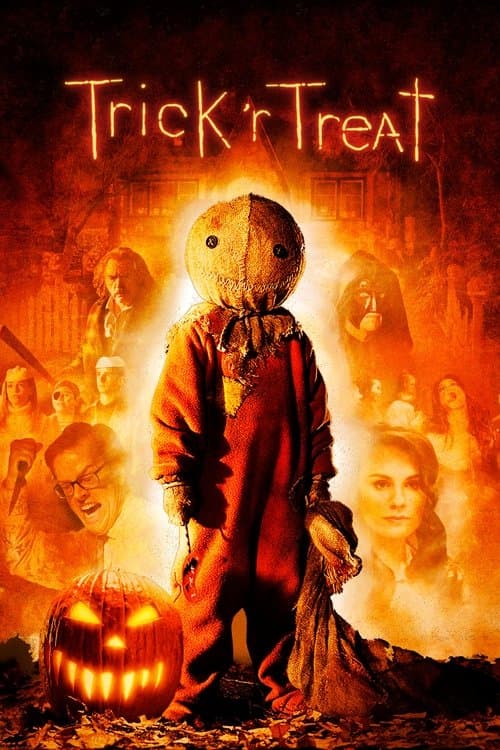
In the shadowy veil of Halloween night, Trick 'r Treat weaves a tapestry of dread and delight, where the line between candy-sweet tradition and bone-chilling consequence blurs. This 2007 anthology horror film, directed by Michael Dougherty, unfolds in the fictional town of Warren Valley, Ohio, through four interconnected tales that pulse with the eerie rhythm of the holiday. At its heart lurks Sam, the enigmatic trick-or-treater clad in an orange footie pajama suit, a pint-sized enforcer whose wide-eyed stare carries the weight of ancient, unspoken rules. As the stories collide in a nonlinear frenzy of pranks, secrets, and supernatural retribution, the film builds to a crescendo that leaves the air thick with unresolved tension—like the lingering chill after a jack-o'-lantern's flame gutters out.
Quick Recap
The film opens on a crisp Halloween evening, where the town's festive facade hides darker undercurrents. Principal Steven Wilkins, by day a stern authority figure at the local high school, harbors a gruesome secret: he's a methodical serial killer, methodically dispatching a former colleague who knows too much about his past crimes. The air hums with the scent of fallen leaves and distant bonfires as he disposes of the body in a storm drain, all while preparing for the evening's parade. Interwoven is the story of Rhonda, a shy college freshman and virgin navigating the awkward thrill of a blind date with a group of rowdy guys at a quarry pit party, their laughter echoing against the cold stone walls like brittle bones.
Meanwhile, a clique of cruel teenagers—Mackenzie, Chip, and their friends—execute a vicious prank on a school bus filled with mentally disabled children, stranding them in the woods with lit jack-o'-lanterns that soon ignite a horrifying fate. The night deepens with the tale of Mr. Kream, a bitter recluse holed up in his dimly lit home, fending off the holiday's cheer until an unexpected visitor—a silent, costumed child—arrives at his door, the knock reverberating like a heartbeat in the still darkness. Throughout, Sam materializes at the edges of these narratives, a squat figure with a burlap sack over his head, lollipop in hand, crossing paths with the characters and tipping the scales toward inevitable judgment. As the clock strikes midnight, the stories entwine, revealing how one night's disregard for Halloween's fragile customs summons a visceral reckoning.
What Happens in the Ending
The finale unfurls like a slow unraveling of fog-shrouded threads, pulling the anthology's vignettes into a unified tableau of horror that lingers in the mind's quiet corners. As the principal, Steven Wilkins, returns home after his illicit deeds, the house feels oppressively still, the faint creak of floorboards underfoot amplifying the isolation. His wife lingers in the kitchen, oblivious, but Sam has already slipped inside—his small form perched innocently on the stairs, eyes gleaming like embers in the low light. Wilkins, mistaking the intruder for a mere child, offers a solitary candy bar, but Sam's demand for "trick or treat" unmet in spirit unleashes chaos. In a frenzy of slashing shadows and muffled screams, Sam dispatches Wilkins with a garden sickle, the metallic tang of blood mixing with the sickly sweet aroma of spilled chocolate from a nearby bowl. Wilkins' severed head ends up bobbing grotesquely in a decorative pumpkin bucket, a macabre centerpiece for the holiday feast.
Cutting to the quarry, Rhonda survives the hallucinatory nightmare spun by her dates, who reveal themselves as werewolves in human guise—or perhaps figments of a deeper terror—through a ritual gone awry. She flees up the winding path, the crunch of gravel under her feet a desperate rhythm against the howls echoing below, escaping into the night as Sam's distant figure watches approvingly from the treeline. The pranksters' reckoning comes in the woods, where the vengeful spirits of the bus children rise from the underbrush, their pale faces smeared with dirt and malice, dragging the teens into the undergrowth amid guttural cries and snapping twigs. Finally, at Mr. Kream's secluded house, the old man's tale of a long-ago curse culminates with Sam revealing his true nature: not a child, but a harbinger who enforces the night's code. Kream, complicit in past sins, meets his end in a blaze of ironic justice, the room filling with the acrid smoke of burning secrets.
The screen fades to the next morning, dawn's pale light filtering through bare branches. A groundskeeper uncovers Wilkins' submerged body in the drain, the water's chill embrace broken by the splash of discovery. Nearby, a couple—Emma and Henry—stroll through the town square, the air crisp with the remnants of pumpkin spice and decay. They approach a massive chocolate cauldron meant for the parade, only to find Sam's tiny, rain-slicked form curled inside, stirring faintly as if awakening from slumber. The film closes on this tableau, the couple's laughter turning to unease, underscoring the holiday's eternal vigil.
The Meaning Behind the Ending
At its core, the ending of Trick 'r Treat symbolizes the inexorable pull of folklore's unwritten laws, where Halloween serves as a liminal threshold between the mundane and the monstrous. Sam's interventions aren't random violence but a visceral metaphor for consequence—the lollipop he clutches evokes innocence twisted into judgment, its sticky sweetness masking the bitter enforcement of rules like "always give candy to strangers" or "respect the dead." The principal's beheading in his own home, surrounded by familial normalcy, represents the fragility of hidden sins; the blood pooling on checkered linoleum mirrors how personal darkness seeps into the communal fabric. Themes of isolation and denial permeate the close: each character's arc ends in exposure, the night's tension resolving into a psychological exhale that questions whether safety is ever truly restored. Sam's emergence from the chocolate the next day suggests the cycle's perpetuity, a subtle reminder that the holiday's mood—playful yet predatory—endures, embedding dread into the everyday like a half-eaten treat left to rot.
Character Arcs and Resolution
Steven Wilkins' journey from authoritative facade to exposed monster culminates in ironic downfall; his secret life as a killer, buried like his victim in the drain, resurfaces through Sam's blade, resolving his arc with a poetic justice that strips away control, leaving only the echo of his screams. Rhonda's transformation from naive outsider to survivor marks a rite of passage; her escape from the quarry's primal chaos affirms resilience, her final glance back carrying the weight of awakened caution, forever altering her innocent worldview.
The prankster teens' arcs shatter in collective hubris—Mackenzie and Chip's cruelty rebounds as they become prey, their laughter silenced in the woods, symbolizing how youthful recklessness invites the shadows it mocks. Mr. Kream, the recluse whose bitterness stems from a haunted past, finds resolution in confrontation; his uninvited guest forces reckoning with complicity in the town's lore, ending his isolation not in peace but in fiery absolution. Collectively, these resolutions tie back to the film's mosaic, where individual failings intersect, enforced by Sam as the impartial arbiter, leaving characters either enlightened or extinguished.
Alternate Interpretations
The ending's ambiguity invites multiple lenses: Is Sam a supernatural entity, a collective hallucination born of guilt, or the town's subconscious manifesting as folklore? One reading posits him as a psychological projection—Wilkins' paranoia materializing the child he ignored, Rhonda's fears shaping the werewolves—turning the horror inward, where the true monster is unchecked id. Alternatively, a more literal supernatural view sees Sam as Halloween's eternal guardian, his survival in the chocolate cauldron implying immortality; the dawn discovery suggests the rules transcend one night, a perpetual curse on Warren Valley. For some, the couple's encounter hints at propagation—will they, too, break the code next year?—leaving the cycle open-ended, a psychological trapdoor into endless unease.
Themes and Symbolism
The ending reinforces themes of tradition's double edge: Halloween as communal catharsis subverted into punishment, where symbols like jack-o'-lanterns (guiding spirits turned weapons) and trick-or-treat (innocent exchange twisted to demand) underscore the holiday's duality. Sam's burlap mask evokes anonymous judgment, a metaphor for societal facades cracking under nocturnal pressure, while the pervasive autumnal decay—wet leaves, cooling air—symbolizes inevitable harvest of one's sins. It subverts slasher tropes by intertwining fates, emphasizing interconnectedness; no one escapes the web alone, amplifying the film's tension as a meditation on isolation's folly in a shared night of masks.
Final Thoughts
Trick 'r Treat's ending masterfully distills its anthology's atmospheric dread into a cohesive shiver, blending visceral horror with psychological depth to create a finale that haunts long after the credits. By literalizing the enforcement of Halloween's "rules" through Sam's unblinking gaze, it crafts a resonant warning: ignore the night's whispers at your peril. This conclusion works brilliantly for its subtlety—evocative without excess, leaving viewers immersed in Warren Valley's lingering fog, pondering their own unopened candy wrappers. For horror fans craving more than jump scares, it's a treat worth savoring, one that redefines the season's chill as something profoundly, inescapably alive.