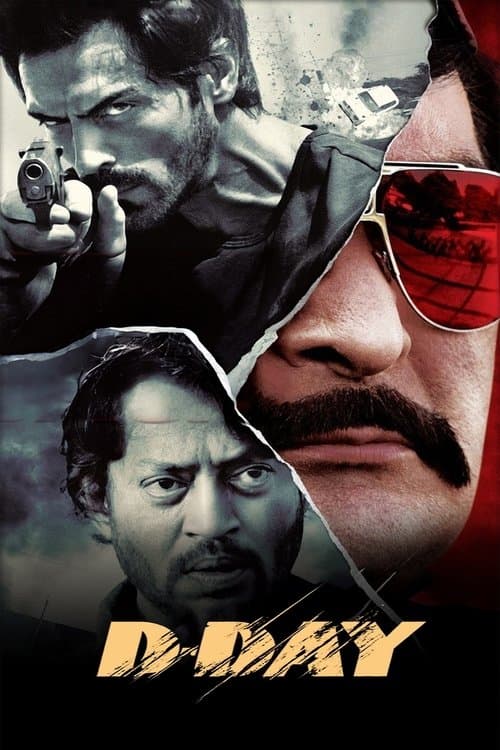
D-Day (2013): Ending Explained
Four Indian agents spend nine years under cover to track down India's most wanted criminal.
8 min read
Release Year: 2013
Rating: 6.583/10
Runtime: 153 minutes
By Luna Sterling
D-Day (2013): Ending Explained
In the gritty underbelly of espionage thrillers, D-Day (2013) delivers a pulse-pounding narrative of sacrifice and betrayal, directed by Nikhil Advani. Starring Arjun Rampal as the brooding Wali Khan, this Hindi action-drama weaves a tale of Indian RAW agents infiltrating Pakistan to capture the elusive criminal mastermind Goldman (Rishi Kapoor). The film's climax is a masterclass in tension, leaving viewers breathless amid the dust-choked borders and shadowed betrayals. If you're searching for a D-Day ending explained, this breakdown dives into the visceral twists, unpacking the literal events, psychological depths, and thematic echoes that make this finale so haunting.
Quick Recap
For nine grueling years, Wali Khan has lived in the shadows of Lahore as a humble barber, his true identity as a RAW agent buried beneath layers of deception. Tasked with tracking Goldman, the ruthless head of D-Company and India's most wanted fugitive, Wali's world is one of stifled breaths and whispered prayers in dimly lit mosques. The plot ignites when Wali overhears Goldman discussing his son's wedding—a rare breach in the criminal's ironclad security. Seizing the moment, Wali alerts his handler, Ashwini Rao, who assembles a ragtag team: Rudra Pratap Singh, a hardened ex-Indian Army mercenary fueled by personal vendettas; Zoya Rehman, the sharp-minded explosives expert; and Aslam, a street-smart Mumbai thief offered redemption through the mission.
The wedding day operation unravels in a haze of chaos and gunfire. Wali stages his family's "death" in a fiery cover-up to protect them, sending his wife Nafisa and son Kabir toward a flight to London. But fate intervenes—flights are grounded, and a chain of suspicions leads the ISI to uncover Wali's double life through innocent clues like pencils from the wedding hotel. The raid erupts into betrayal: Goldman slips away, the agents are exposed, and the Indian government disavows them, leaving Ashwini to resign in quiet defiance. Scattered and hunted, the team regroups amid the humid docks of Karachi, where Aslam endures brutal torture before Rudra's vengeful rescue. United by loss—Wali believes his family perished in the flames—they vow to finish the job alone, the air thick with the metallic tang of desperation.
As the agents close in, the ISI turns on Goldman, deeming him a liability. In a daring ambush, Wali, Rudra, Zoya, and Aslam overpower the protectors and seize their prize. But Goldman's serpentine taunts fracture the group: he claims Wali's family lives, dangling a poisoned reunion. Torn by grief and duty, Wali's psyche unravels, setting the stage for a finale drenched in moral ambiguity and borderland dread.
What Happens in the Ending
The film's denouement unfolds like a fever dream in the pre-dawn chill, every shadow laced with the acrid scent of gunpowder and betrayal. With Goldman captive in a dimly lit safehouse, the air humming with unspoken tensions, Wali contacts Ashwini for an extraction route: Checkpost 35 by 6 AM. But Goldman's whispers burrow into Wali's mind like thorns—he promises to broker the safe return of Nafisa and Kabir, still alive in ISI custody. The psychological vise tightens; Wali, eyes hollow with torment, shoots Rudra in a bid to seize control, his hand trembling against the cold steel of the gun. He disarms Zoya, binds Rudra, and drives off alone with Goldman toward what he believes is an exchange at Checkpost 40, the border's fog-shrouded no-man's-land.
Unseen by Wali, Zoya frees Rudra, and they tail him in the other vehicle, the engine's low growl cutting through the night's oppressive silence. At the checkpost, Pakistani forces—forewarned and ruthless—ambush Wali's car. Bullets rip through the metal, and Wali slumps dead over the wheel, blood pooling in the dim glow of dashboard lights. As soldiers pry open the vehicle, they find it empty save for Wali's lifeless form—no Goldman. The camera pulls back to reveal the deception: in a series of taut flashbacks, we see Wali and Rudra's clandestine plan. Anticipating the betrayal, Wali had swapped vehicles en route, leaving Goldman bound and gagged in the car with Zoya and Rudra. The switch was a desperate gambit to force Goldman's compliance and buy time for the real escape.
Pursued by a convoy of screeching tires and flashing lights, Zoya and Rudra race toward the border, the desert wind whipping sand into their faces like needles. They cross just as dawn bleeds red across the horizon, Ashwini waiting in the haze. Goldman, unbound but defiant, smirks through cracked lips, mocking the futility: "Nothing changes in India—you'll release me soon, and I'll be back." Rudra's face hardens, the weight of years pressing down. In a visceral crescendo, he shoots Goldman in the left arm, then the right leg, shattering the criminal's smug facade. Yanking off his signature dark glasses, Rudra delivers the final headshot, the crack echoing like thunder. As Goldman's body crumples into the dust, Rudra declares, "This is the face of the New India," his voice a raw rasp against the morning's uneasy quiet.
The Meaning Behind the Ending
At its core, the ending of D-Day symbolizes the brutal rebirth of justice in a world of endless cycles—personal vendettas morphing into national reckonings, with the border as a scarred vein pulsing with unresolved rage. Goldman's execution isn't mere revenge; it's a metaphorical severing of old ties, Rudra's bullets dismantling the criminal's armored persona (those glasses, a shield of untouchability) to expose the rot beneath. The visceral imagery of dawn breaking over the bloodied sands evokes a fragile hope amid carnage, suggesting that true capture means not just physical restraint but psychological domination—breaking the man's spirit before his skull.
Thematically, the finale grapples with the cost of loyalty in espionage's moral wasteland. Wali's sacrifice underscores the theme of illusory family versus unyielding duty, his death a pyrrhic victory that haunts like a ghost in the machine of statecraft. Goldman's taunts represent the seductive pull of corruption, a psychological siren call that nearly derails the mission, mirroring how personal losses fuel the agents' descent into vigilante shadows. Yet, in Rudra's "New India" proclamation, the ending asserts a defiant evolution: from covert whispers to bold, unflinching action, where mercy is a luxury long abandoned.
Character Arcs and Resolution
Wali's arc crescendos in tragic irony, his nine-year masquerade as the stoic family man shattering under grief's weight. Believing his loved ones lost to flames and poison, he embodies the spy's ultimate alienation—shooting Rudra not from malice but fractured desperation, only to orchestrate his own demise in a selfless feint. His death resolves his journey as the mission's quiet architect, a visceral reminder that some borders can't be crossed alive, leaving his "reunion" as an eternal echo in the wind-swept dunes.
Rudra emerges transformed from vengeful mercenary to symbol of renewal. Haunted by Suraiya's murder, his arc peaks in the execution scene, where controlled fury replaces blind rage. Shooting Goldman methodically—limb by limb—purged his personal demons, culminating in the "New India" line that resolves his isolation into purposeful agency. Zoya and Aslam, though less spotlighted, find closure in survival's grit: Zoya's explosives expertise aids the escape, her arc affirming quiet competence amid chaos, while Aslam's redemption arc solidifies through loyalty forged in torture's fire. Ashwini's steadfast support ties their resolutions to institutional resilience, even as the government's disavowal fades into irrelevance.
Alternate Interpretations
The ending's layered deceptions invite ambiguity, particularly around Wali's final moments. One reading posits his death as a deliberate martyrdom, the flashbacks revealing a man who foresaw betrayal and chose erasure to ensure success—his "family" exchange a ploy to draw fire. Alternatively, it could be interpreted as unintended tragedy: perhaps Wali's plan hinged on partial trust in Goldman, and the shooting stems from genuine hesitation, making his demise a poignant failure of the human spirit against systemic deceit.
Rudra's killing of Goldman sparks debate—is it triumphant justice or a descent into the very vigilantism the agents fought? Some see it as subverting heroism, with Rudra becoming a mirror of Goldman’s ruthlessness, perpetuating violence across borders. Others view it as cathartic necessity, the ambiguity heightening the tension between state-sanctioned capture and raw, personal reckoning in a lawless world.
Themes and Symbolism
D-Day reinforces themes of fractured identity and the blurred line between hunter and hunted, with the ending amplifying espionage's psychological toll—the constant hum of paranoia like a distant drone in the night. Symbolically, the border checkposts loom as liminal thresholds, foggy barriers where illusions die: Wali's empty car a hollow vessel of sacrificed dreams, while the real convoy's dash evokes the frantic heartbeat of survival.
The film subverts traditional spy tropes by grounding heroism in visceral losses—family as collateral in the shadows of power. Goldman's glasses, shattered in death, symbolize the illusion of invincibility, while the dawn light piercing the gunfire reinforces themes of cyclical renewal tainted by blood. Broader, it probes Indo-Pak tensions through personal lenses, the "New India" motif subverting nationalism into a gritty manifesto against complacency, where victory tastes of dust and gun smoke.
Final Thoughts
D-Day's ending works masterfully because it trades explosive spectacle for emotional viscera, leaving audiences in the unsettled hush after the shot—a border crossed not just geographically, but into the moral gray of what justice demands. It's not a tidy resolution but a lingering ache, immersive in its portrayal of agents as broken vessels adrift in tension's tide. For thriller fans craving depth beyond the action, this finale cements the film as a standout, its ambiguities inviting rewatches under the weight of what-ifs. If espionage's shadows intrigue you, D-Day reminds us: in the end, the real capture is of the soul.