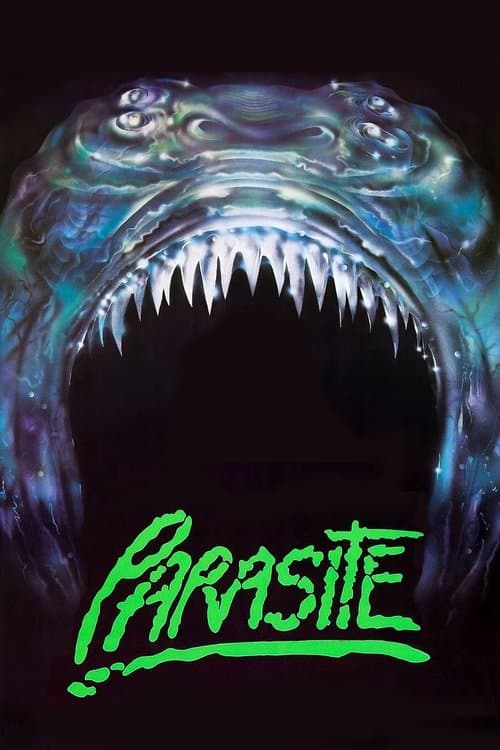
Parasite (1982): Ending Explained
"You will not feel the terror until you experience the movie!"
Paul Dean has created a deadly parasite that is now attached to his stomach. He and his female companion, Patricia Welles, must find a way to destroy it while also trying to avoid Ricus & his rednecks, and an evil government agent named Merchant.
8 min read
Release Year: 1982
Rating: 4.8/10
Runtime: 85 minutes
By Luna Sterling
Parasite (1982): Ending Explained
By Luna Sterling
In the gritty, shadowed underbelly of 1980s sci-fi horror, Charles Band's Parasite (1982) slithers through a post-apocalyptic wasteland where desperation clings like damp rot. This low-budget gem pulses with the raw tension of survival, blending body horror with a chase narrative that leaves you feeling the itch of unseen threats. If you've just emerged from its feverish finale—heart pounding, skin crawling—welcome. This ending explained dives deep into the film's visceral close, unpacking the chaos, the symbolism, and the lingering unease. Spoilers ahead, naturally.
Quick Recap
In a ravaged future scarred by atomic fallout, society has crumbled into a playground for the tyrannical Merchants, a shadowy organization that preys on the remnants of humanity. Dr. Paul Dean, a reluctant scientist coerced into engineering a monstrous parasite—a ravenous organism designed to feed on and control hosts—escapes their clutches. In his flight, the parasite latches onto him, burrowing into his gut like a living curse. Haunted by its grotesque lifecycle, Paul roams desolate towns, notebook in hand, desperately seeking a way to eradicate it while evading Wolf, a ruthless Merchant enforcer whose pursuit feels as inevitable as decay.
The story coils tighter in a sun-baked desert outpost, where Paul crosses paths with Patricia Welles, a resilient lemon grower whose quiet determination cuts through the arid despair. Their fragile alliance is shattered when a ragtag gang of scavengers—led by the brooding Ricus, a former Merchant slave—ambushes Paul and steals the silver canister housing the parasite. Unwittingly unleashing the beast, the gang watches in horror as it infects one of their own, spreading a fleshy, insatiable hunger. Ricus, torn between loyalty and survival, seeks Paul's aid, drawing Wolf's predatory gaze. As the parasite mutates, growing into a toothed abomination that drips with viscous menace, alliances fracture amid the dust-choked tension, pulling Paul, Patricia, and a handful of unlikely allies into a claustrophobic nightmare of pursuit and infestation.
What Happens in the Ending
The finale erupts in a frenzy of guttural snarls and acrid smoke, transforming the dingy motel room into a slaughterhouse of squelching horror. Paul, still host to the original parasite, writhes under its internal grip, his skin slick with feverish sweat as the creature's tendrils pulse visibly beneath. Patricia, her hands steady despite the metallic tang of fear in the air, rigs a makeshift device harnessing high-pitched sound waves— a piercing whine that vibrates through the bones like shattering glass. The frequency targets the parasite's vulnerability, forcing it to detach from Paul's abdomen in a spray of bile and writhing segments, collapsing into a quivering heap on the bloodstained floor. The relief is palpable, a momentary hush broken only by Paul's ragged breaths, but the air thickens with dread as the remaining parasite—now a hulking, fleshy worm lined with jagged teeth that glint like shattered obsidian—slithers from the shadows.
This abomination, swollen from its rampage through the gang, lunges at Wolf, who has burst into the fray with gun drawn, his face twisted in the cold fury of the hunt. The parasite engulfs him in a tangle of slimy coils, its maw clamping down with a wet crunch that echoes the film's primal savagery. Seizing the chaos, Paul, Patricia, and the diner owner Collins—a grizzled everyman whose unexpected grit smells of greasy counters and quiet resolve—act in unison. They douse the entangled mass with accelerant, the fumes sharp and eye-watering, and ignite it with a improvised blast. Flames roar up, consuming Wolf and the parasite in a blistering inferno that paints the room in flickering orange hellfire, the screams mingling with the crackle of burning flesh until silence falls, heavy and final, over the smoldering ruins.
The Meaning Behind the Ending
At its core, this explosive denouement symbolizes the devouring cycle of control and rebellion in a world stripped bare. The parasite isn't just a monster; it's a metaphor for the Merchants' insidious grip on society—a parasitic force engineered to infiltrate and dominate, mirroring how power preys on the vulnerable. Paul's self-inflicted infestation represents the personal toll of resistance: the intimate horror of carrying the enemy's weapon within oneself. The sound waves that liberate him evoke a cathartic rupture, a high-frequency truth that shatters illusion, suggesting that destruction demands confronting the rot head-on, no matter the visceral cost.
The parasite's final assault on Wolf flips the script on predation, with the hunter becoming the devoured—a poetic irony that underscores themes of inevitable backlash. In blowing up the enforcer alongside the beast, the survivors don't just kill a threat; they incinerate the symbols of oppression, leaving behind the stench of scorched ideology. Yet, the mood lingers with psychological unease: the flames may purge the immediate horror, but the wasteland outside remains, implying that such victories are fleeting in a society where parasites—literal or figurative—regenerate from the ashes.
Character Arcs and Resolution
Paul Dean's journey arcs from coerced creator to haunted fugitive, culminating in a hard-won emancipation that feels both triumphant and hollow. Infected and isolated, his intellectual pursuit of the parasite's weakness evolves into a visceral fight for his humanity, ending with him purged but forever marked by the ordeal—the psychological scars of violation etched deeper than any wound. Patricia Welles, the outsider ally, transforms from a solitary grower into a fierce catalyst, her ingenuity with the sound device resolving her arc as a beacon of resourcefulness amid despair; she emerges not unscathed, but empowered, her hands stained with the residue of survival.
Ricus's betrayal-turned-redemption is tragically truncated—his death at Wolf's hands severs his path from gang leader to reluctant hero, a visceral reminder of divided loyalties in a fractured world. Collins, the peripheral diner owner, rounds out the ensemble with understated resolve, his aid symbolizing the quiet solidarity of the overlooked. Wolf's fiery end resolves his arc as the embodiment of merciless authority, reduced to cinders, while the gang's remnants fade into irrelevance, their infections a cautionary echo. Collectively, the survivors' resolution breathes a tense reprieve, but the psychological tension hums: freedom tastes like smoke, fragile against the endless horizon.
Alternate Interpretations
While the ending's literal violence is unambiguous, its ambiguities simmer in the aftermath's void. One reading casts the explosion as a pyrrhic triumph: Paul and Patricia escape physical infestation, but the Merchants' shadow looms, suggesting the parasite's destruction merely delays a larger infestation—perhaps the organization will breed more, rendering the finale a futile spark in an unending night. Alternatively, the high-pitched waves could symbolize a broader awakening; maybe the sound's resonance spreads subtly, hinting at a ripple effect that erodes the Merchants' control, turning the ending into a seed of revolution amid the carnage.
For the psychologically inclined, Wolf's demise by the very weapon he hunted might imply a karmic loop, where the parasite represents repressed societal rage finally consuming its oppressors. Or, in a bleaker lens, the survivors' act of blowing everything up foreshadows their own corruption—did they inherit the Merchants' destructive zeal? These interpretations thrive on the film's tense ambiguity, leaving viewers to ponder if the horror truly ends or merely mutates.
Themes and Symbolism
The ending reinforces Parasite's core themes of exploitation and resilience, subverting the sci-fi trope of the unstoppable monster by making it a tool of the powerful, only to backfire in grotesque symmetry. Symbolically, the fleshy worm embodies unchecked consumption—the atomic wasteland's legacy of devouring everything in its path—while the desert town's isolation amplifies the claustrophobic dread of infestation, where personal boundaries dissolve like melting flesh. Fire as the ultimate purifier subverts destruction's finality; it cleanses but scars, echoing how rebellion in this world births new monstrosities.
Broader motifs of class and control pulse through: Ricus's slavery and the gang's scavenging highlight the underclass's vulnerability to engineered horrors, while Paul's escape critiques scientific hubris. The ending subverts expectations by blending horror with uneasy hope, reminding us that in a parasitic society, survival demands burning it all down—yet the ashes whisper of regrowth.
Final Thoughts
Parasite's ending works its magic through sheer, sweat-drenched intensity—a visceral payoff that doesn't overstay its welcome, leaving you with the metallic aftertaste of adrenaline and the subtle chill of what's unsaid. In a genre often bloated with excess, this climax distills the film's lean terror into a bonfire of catharsis, rewarding patient viewers with layers of meaning beneath the gore. It's not flawless—the budget's constraints sometimes blunt the horror's edge—but its atmospheric punch lingers, a testament to how low-fi dread can burrow deep. If Parasite haunts you, it's because endings like this don't just resolve; they infest your thoughts, promising no easy escapes in our own fractured world.